


Sorry to get all Borges on you again, but one of the things that he taught me is that you can take religion and other complex systems and play with the ideas. He loved reading the Bible, all the unique metaphors involved in telling the stories, like “Do not throw your pearls before swine.” He was awed by that one!
But he read the Bible as if it were fantasy literature, the same way he read 1001 Nights and the tales of Robert Louis Stevenson. He also read Kabbalah, Chinese Philosophy, and one of his favorite books that he read many times was Bertrand Russell’s Introduction to Mathematical Philosophy, which he loved.
I confess that when I heard about his fascination with the book, I got a copy and tried to get through it. It is a thin volume, but it’s packed with dense material and I had to read it with intense focus, and so far have only got through a quarter of the book. But I’m not dead yet, and it’s still on my bookshelf, available for me to pull out and to read it when the time is right.
He didn’t read Russell because of some hidden ambition in the mathematical world. Rather he read it as fantasy literature. It allowed him to expand his own imagination and create stories like nobody had ever created before, such as “Tlön, Uqbar, Orbis Tertius,” which I’m willing to imagine was inspired or ran parallel to when he read Mathematical Philosophy.
I was struck by a detail from chapter two, a short passage about Gottlob Frege, a German Philosopher and mathematician who published a book that defined numbers in such a way that mathematics could have moved forward. The name of the volume was Grundlagen der Arithmetik, but when it was published, it got no attention. Nobody noticed it. It wasn’t until years later when Frege’s text was discovered and mathematical philosophers like Russell and Ludwig Wittgenstein realized the idea had always been there –and for a long time.
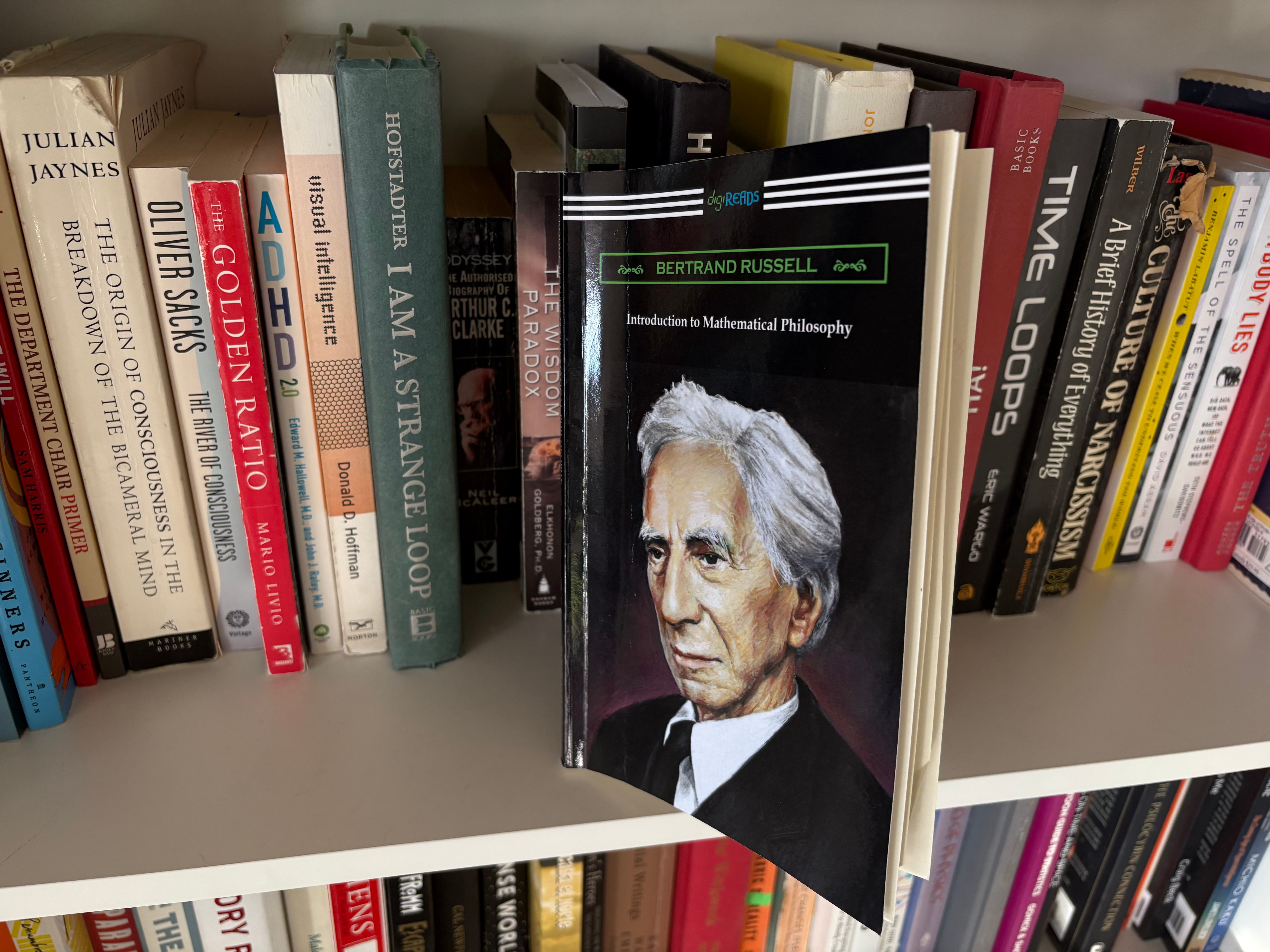
This is like a plot detail from a Borges story! Someone finds an obscure book that explains the mysteries of reality, or they find references in the footnote of an obscure book and follow that idea into deeper and deeper philosophical territory. Borges treated philosophy, religion, science, as toys for the writer to play with.
All books are fantasy literature.
I think this is a good way for writers to think. We can believe in science or math or God or whatever we want to believe in, but we should also be able to play with the ideas and details like a child plays with dolls.
It could be good for a writer to not take any system too seriously, but to play with the ideas, to hop from system to system and be a systems thinker. I advise my students, or any writer who asks, to not just read novels and poetry, but technical books about any subject. Have you been thinking about trees, noticing them lately? Read a scientific book about trees. Read across disciplines, but not to try to learn something per se, or to “expand” your knowledge, but for fun, like you were reading a fantasy story. Let the ideas influence you. Let the spirit of the trees appear in your own work.
(Here is a short list of fun books that writers can use to expand their imaginative possibilities.)
A Brief History of Time by Stephen Hawking.
The Elegant Universe by Brian Greene
7 1/2 Lessons About the Brain by Lisa Feldman Barrett
The Distorted Cosmos by Chandra Prescott Weinstein.
Chuco Punk by Tara Lopez.
The Meme Machine by Susan Blackmore.
Looking for Spinoza by Antonio Demasio.
Gödel, Escher, and Bach by Douglas R Hofstadter.
These are so many more, but just have fun!