

REASON ONE
Mundus Imaginalis

Years ago, I decided to spend the summer in Michoacán, mostly Morelia, but I took 10 days and went to Pátzcuaro, a small town a short bus ride from the city, famous throughout Mexico for hosting the largest Day of the Dead celebration in the world. I went there following a creative impulse, a writer seeking hidden truths about the world, thinking that, maybe if they loved and honored the dead so much there, I could connect to spirits from the past and they can show me things. Really. That’s how weird I was.
I wanted to walk with the dead.
And that’s exactly what happened.
It was one of the strangest summers of my life, when I witnessed so many serendipitous and weird --freaky woo-woo things that it could fill a book.
But one of the central images of my entire creative life comes from those 10 days, and it’s an image that today reinforces what I believe is true:
LLMs can never write poetry like a human.
They do not have the ability and the resources of what I discovered during my stay in that town: Access to the imaginal realms, the Writer’s High.
One day I took a boat to the island of Janitzio. It’s a small island about a 30-minute boat ride from the Pátzcuaro pier, and when you get out, you are greeted by natives in traditional dress selling anything a tourist might want, who are mostly people from other parts of Mexico, mostly Mexico City.
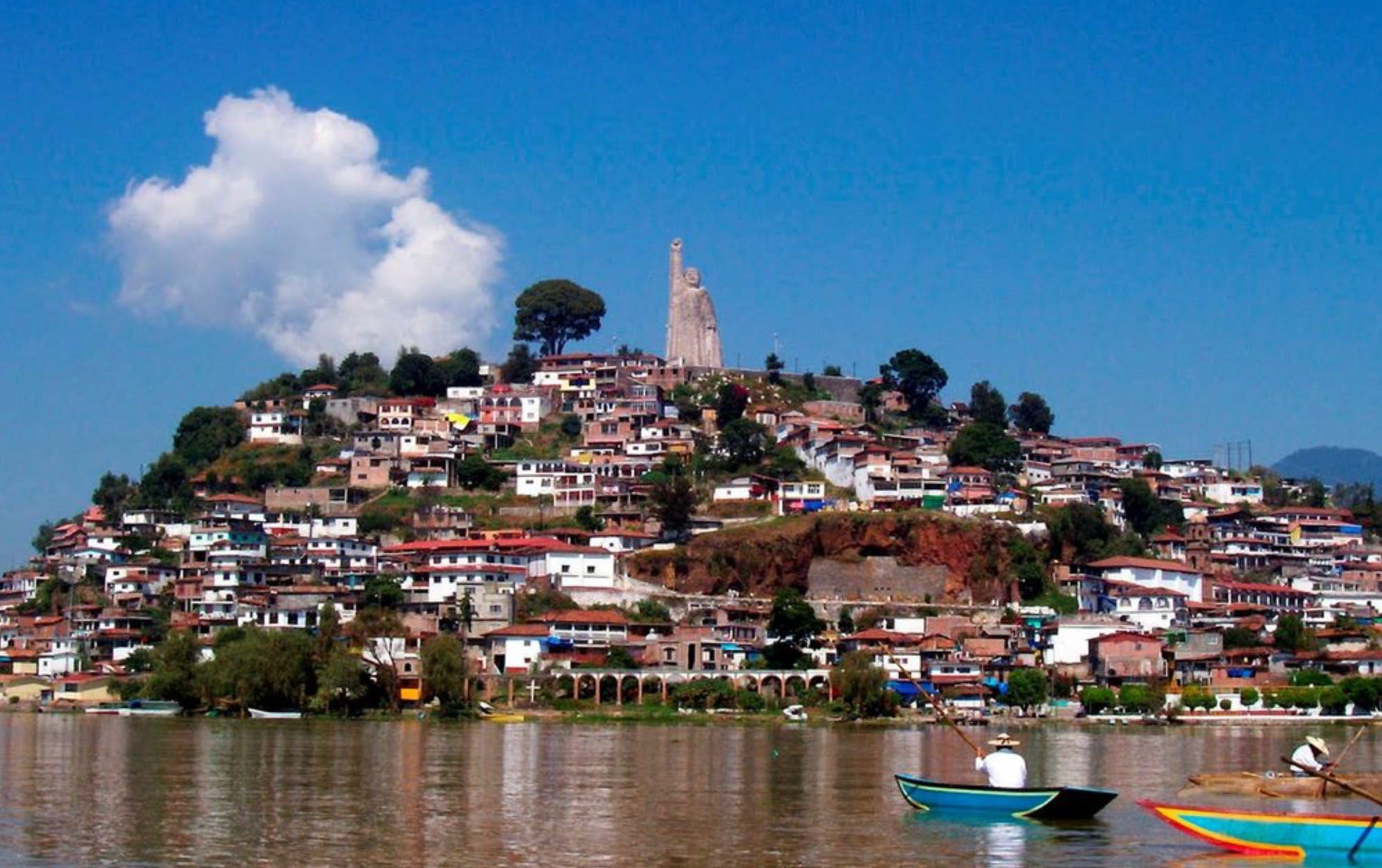
They have tables with bottles of rum and brandy and they’ll make sugary drinks in exotic clay cups. They sell all kinds of kitschy items, including little figures of the man whose statue stands in the middle of the island, José María Morelos. On the islands people will sell you hats and mugs and charales fritos, little fried fish for a crunchy snack, and ambulant ladies carry baskets of candy, bees swarming around them—that they sell to tourists with kids. It was all very touristy, but nonetheless, I got a glimpse beyond the veil into the archetypal realm of things.
There are no cars on the Island so to get to the top of the hill, where the Morelia statue stood, you had to walk winding, unpaved streets, and along the way there were shops and places to eat, and always those ladies carrying baskets of candy.
As I was walking to the top, I came upon a crossroad, and the ladies selling candy were walking one way, and coming from the other direction was a band of músicos, indigenous men with horns and drums and guitars playing music that was upbeat and cheerful and occasionally dissonant, and that imperfection of sound --a horn going on for too long or missing the precise note --was beautiful. The ladies and the men reached the center of the intersection at exactly the same time, and the ladies started to dance to the music, spinning around in their colorful dresses leaving blurs like spinning roses, their baskets of candy twirling colorful as well, the bees popping around them like electrons around a nucleus.
I came out of my body. I felt as if I were watching the scene from above, seeing the cross in the crossroad, and I understood that the image was archetypal and existed outside of space-time, that I was looking into the twirl of energy and seeing something eternal.
I still see it, but at the time, as I watched the ladies dance, I thought of Garcia Lorca and how he might have encountered an image like this, maybe gypsy ladies arriving at a crossroads and men with guitars going the other way. An impromptu poem.
But here’s the thing, and this is probably hard for some people to imagine but try: I looked across the street and I saw Lorca looking back at me.
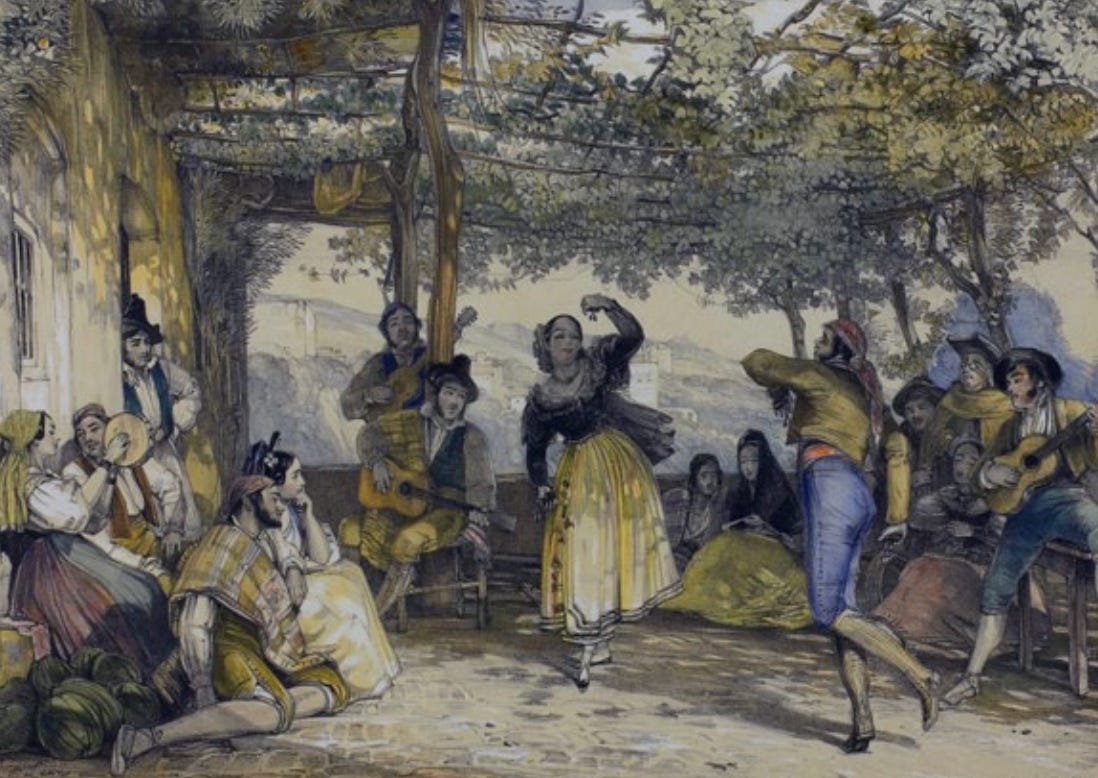
We looked at each other, and then we looked at the ladies dancing and the men playing music, and then we looked at each other. He made a face at me, and I made a face at him, as if we were wondering who would be the first to write about this? I mean obviously he would write it first in chronological terms, but like Borges and many other writes have pointed out, including physicists, chronological time is only a way for humans to organize their own understanding of reality, but it’s not true in itself. Lorca and I weren’t in a competition to write about the crossroad, one which he would have won; it was just an acknowledgement, like saying, Yeah! I see it too!
Obviously, I was imagining it all. It wasn’t really there. Not in this world, not in the material world, but I also knew that it was real, and it wasn’t about me or Lorca.
It was about the spirit of the human poet to connect to an image so viscerally, to find the eternal beauty in it, and to want to share it in written form. I was seeing something more real than the spacetime that I was in. If I look at that day now, my memory blurs. What year was I there? Was I with somebody on the island? When I got off the boat, did I ask for a strong rum drink and carry it around with me, sipping through a red straw as the ladies danced?
What I write now is not an accurate representation of what I saw. Rather what I saw was the accurate representation of itself, outside of spacetime.
When I snapped out of my “trance,” Lorca wasn’t there. I was in Janitzio and it was circa 2013. But my image of him was real, and I know there are times when I encounter an image that is so archetypal, so packed with multiple possibilities of meaning, that there are others witnessing the same thing, outside of my spacetime.
Henri Corbin, a French philosopher who died in 1978[1], articulated what I think poets know intuitively, that there is an imaginal world that artists can enter into and linger for a while, but not just artists, physicists as well, philosophers, scientists, and anyone (I believe) who enters the Flow state, the Writer’s High.
When we reach the Writer’s High, we leave our bodies and enter into imaginary realms. Corbin believes that this imaginal world, what he called the Mundus Imaginalis, is real and autonomous; that is, it exists with or without us.
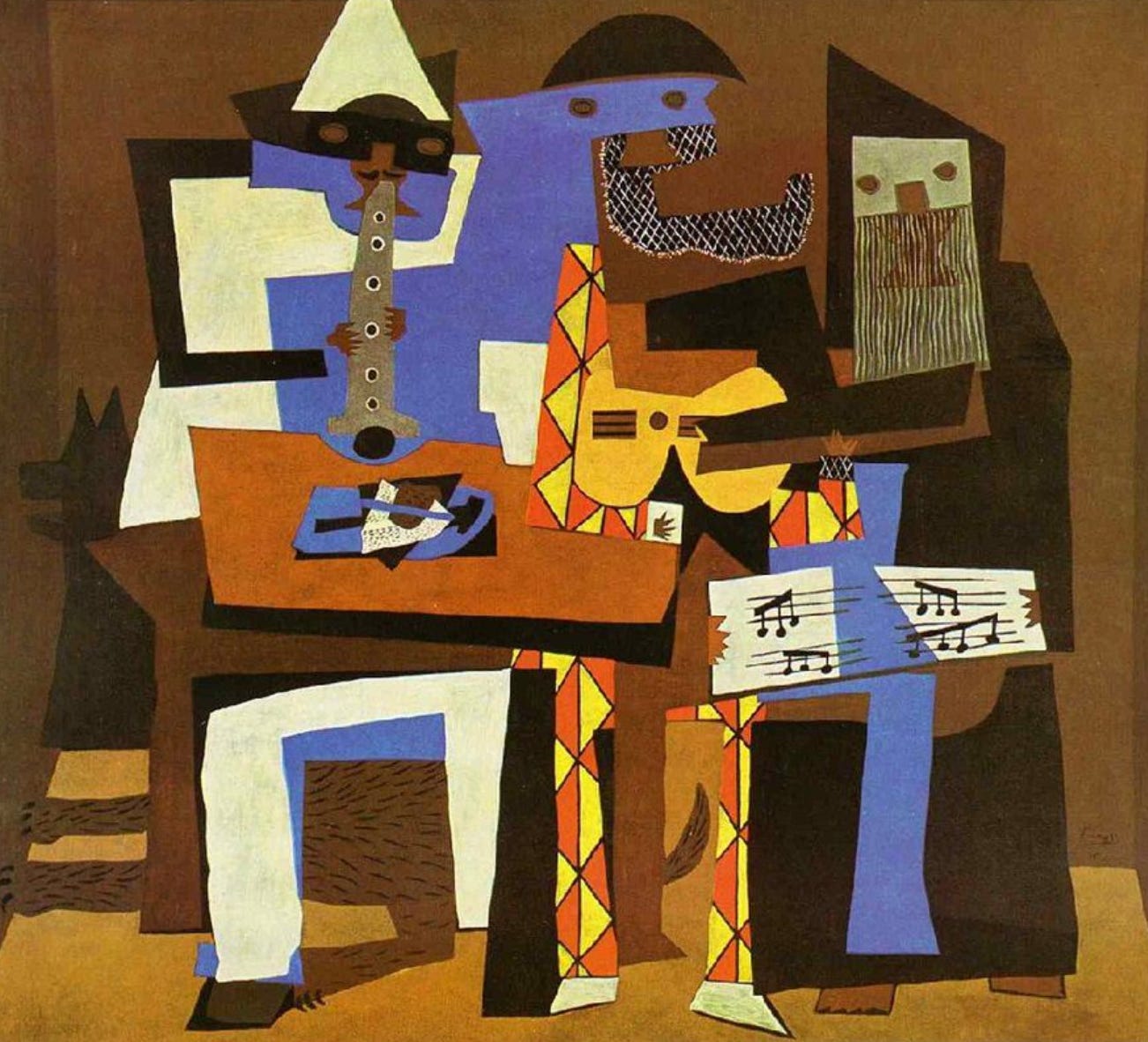
We don’t create imaginary worlds, we access them, we enter into them, and this is why there are so many examples of literary --imaginary --artistic –scientific-- Zeitgeists, when people discover the same things around the same time, because a particular cultural mindset rooted in an era can allow us --when in deep cognitive states -- to glimpse certain imaginary worlds, and we find portals. I believe it is a zeitgeist that Picasso started with his Cubist direction at the same time that physicists were discovering the strangeness of elementary particles and Plank’s quantum hypothesis and how what we see does not represent what is actually there, and although I do not claim Picasso studied physics, there was a lot of buzz around the time that he was exploring reality deconstructed into facets.
If we are writing poetry, we can find that imaginal world when we are willing to submit to the language. We can access that imaginal, and although Corbin did not frame it this way, I think it’s pretty obvious that when we enter into the Mundus Imaginalis, because it is “real and autonomous,” we can run into some of our antepasados. Kafka is a great example of how this is possible. I don’t know what he was like, but I do know that he would get into these moments of writing wherein he left the real world and entered into a world that was weird, yes, but nonetheless that we knew on some fundamental level was real. And as a reader, when we enter into a Kafka world, we are often able to access the portal and go into his world and experience it, and because the world is real and autonomous we might very well run into, for example, Borges, who spent a lot of time inside. We can run into him and have a conversation, although not a conversation in the sense that we do in this world, but an imaginary conversation, like my encounter with Lorca, which is real.
At this point, AI cannot do that. I’m not sure it will ever be able to do that. The Mundus Imaginalis may very well be the last refuge for humanity, where we can escape our AI overlords. And if this comes to pass, the Creative Writer will be more necessary than ever.
We can never give up creative writing, because it is our access into a real and autonomous world that exists side-by-side with ours. If you were a theoretical physicist, you could even say the Mundus Imaginalis is one universe within the Multiverse.
The sad fact is that many people today are addicted to technology and algorithmic influence on their thinking, their spirituality, and their emotional lives. They cannot never leave this world, will never find the portals because of all the information they take in, information after information after information, so much so that the processing is impossible, except for on unconscious ways that spark our emotions and take over our brains.
(OK, that’s it for this post. The next one I will write about the other reason why LLMs will never replace the human Poet. As some of you know, this started out as the outline for my lecture in Paris called “The Biology of Poetry,” but there’s a difference between writing things down and giving a lecture, and this has just become its own thing. I was going to record the lecture which was only a half an hour certainly not enough for me to say much, would’ve needed several hours, but I pulled out the mics, turned them on, but I forgot to hit record so all I have is this short excerpt from an interview with the Aleph-Écriture.)
[1] Here’s something incomprehensible to me, the detail that I had to add regarding the year he died, 1978. I don’t know why I remember that about him, but every time I say his name, my language always wants to say after (like a chant) who died in 1978. 1978, as if that were somehow significant. Perhaps there’s something in my life that occurred in 1978 that I don’t consciously remember but that is somehow interwoven in my nervous system, encoded in my memory, and so every time I hear that year, 1978, it strikes me and makes me feel something. In 1978 I was 16 years old, my hair down to my butt, and I was often stoned, hanging out with my friends having impossible conversations. I wonder if during that time I got a glimpse into another realm and perhaps that’s why that year sticks with me. But I have no idea why I always say, after his name, who died in 1978.
"We can never give up creative writing, because it is our access into a real and autonomous world that exists side-by-side with ours... you could even say the Mundus Imaginalis is one universe within the Multiverse." Yes! This sums it up. I think of some writers like Flannery O'Connor nodding from the grave.
Thanks for the trip to mundus, imaginalis. I'm glad I got a preview before it's the only thing left.