
Train GOTO 1976
My Father Was Crazy

Before there were computers, my dad built a computer.
Well, sort of.
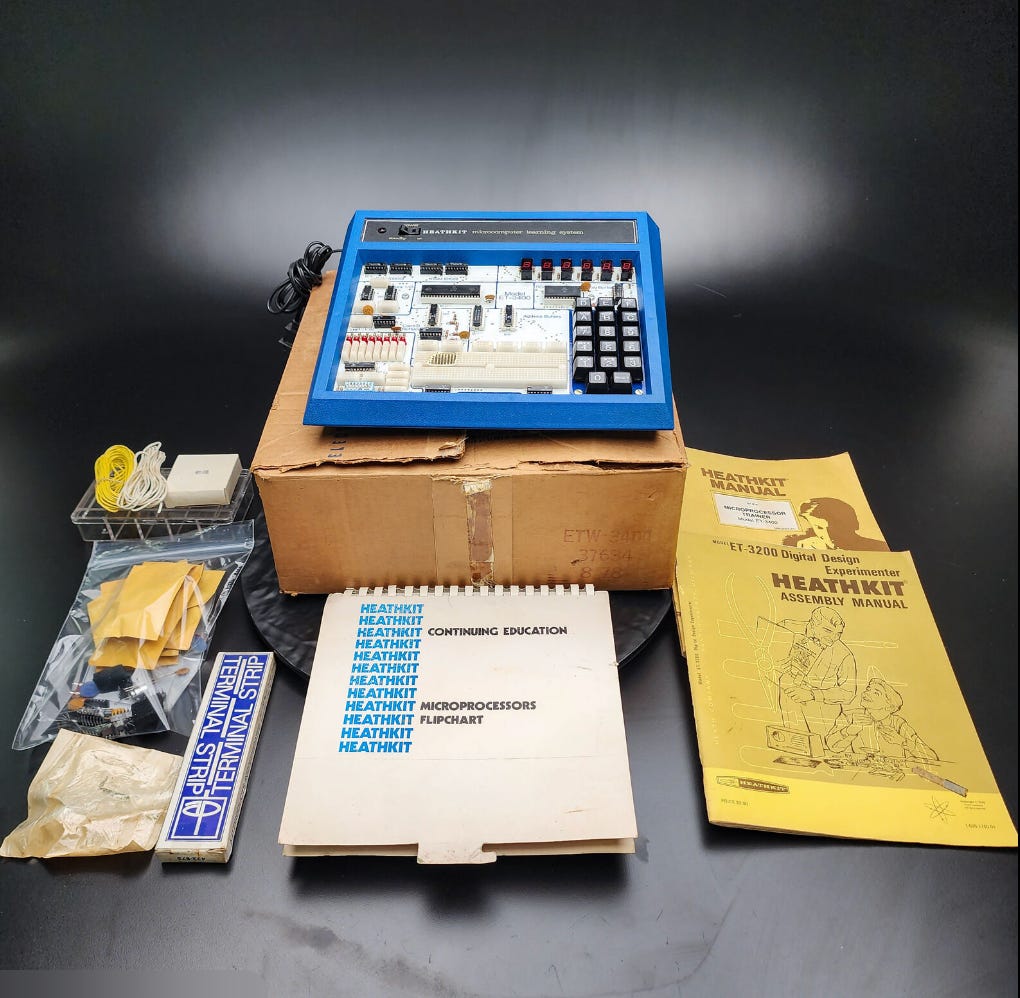
It was a Heathkit ET 3400, designed as an educational tool to help people understand how computers work. The kit allows users to build their own “computer” and to use basic coding techniques to make it do something. This was circa 1976, before personal computers, so most of us didn’t even use the word computer.
He was very excited when it arrived, carrying the box into the house as he talked and talked with the enthusiasm of José Arcadio Buendía from 100 Years of Solitude, a crazy man unpacking the box of scientific-looking instruments. The electrical parts and circuits made no sense to us, or this blue board where there were controls and a keyboard. My mom shook her head, couldn’t believe he had spent the money on such a stupid whim. My brother and sister rolled their eyes. I couldn’t stop staring at it.
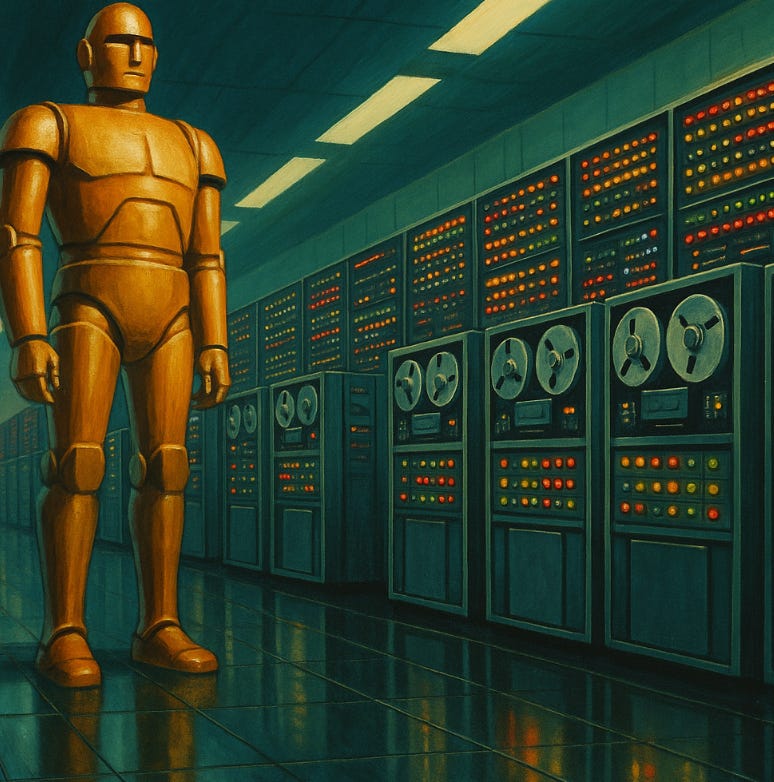
All the colors and the electronic-futuristic looking parts exploded in my imagination, not because I was curious about how it worked, but because it brought me into a scene from a movie where there are rooms with giant computers as tall as robot warriors, running reel to reel tapes and a lot of blinking lights. It transported me to the future. Maybe I was seeing the future.
For months, my father would come home from work, take a nap, eat dinner, and then he would sit at the kitchen table putting that computer together, while the rest of us watched TV.
He was so excited.
He would yell out, Look! Look at this!
I don't remember exactly what he said, but I know he told us the future would be built on mathematics, so if you could understand computational thinking, there would be nothing you couldn't do, even magic. I don’t recall if he knew about the Arthur C. Clark quote that any new advanced technology is indistinguishable from magic, but that is essentially what he was saying. Computers will be magic.
And he was going to learn how they worked.
Maybe he was caught up in the niche zeitgeist among the technologically curious that the world was going to be taken over by computers, that they were going to be part of every day, and he didn’t want to be left behind.
He subscribed to so many tech and mathematical magazines that he must have seen ads for this kit, maybe even read an article about it.
He would put in basic code and it would do things, flash text or pixelated images of something, rudimentary graphics reminiscent of what we now think of as early computer screens.
One time when nobody was around, I sat in front of the ET-3400, turned it on, and I started to enter a code that I had found in this tiny booklet that came with the kit.
It said if you enter this code, something will happen, but it didn't tell us what, and I was excited.
So I sat down and I copied it exactly.
This was long before HTML. The code used commands like GOTO, with lines such as 20 GOTO 10. I didn't understand any of it, I intuitively understood that the GOTO command was “go to”, so if this, then go to that. If x then y. If something is input, then there will be an output, something will happen. Now I understand that this is the basic way computers work, the basic way Artificial Intelligence works. If this, then that.
But back then it seemed like I was creating magic. I entered the code, sitting there for hours, and I remember when I thought I was done, I hit the enter button and nothing happened. I had made an error, so I I had to go back and see where I might have left out of comma or a GOTO.
But when I finally got it right and I hit that enter button on the screen, there appeared a pixelated cartoon of a train! Created by typing numbers and words!
The train was moving across the little screen my dad had hooked up, moving slowly to the other side, and there was a little smoke stack and little puffs of pixeled smoke come out. And the train kept moving, moving all the way across the screen, until it disappeared.
That train wasn't real. But it's still with me.
So maybe it's more real than my idea of a train.
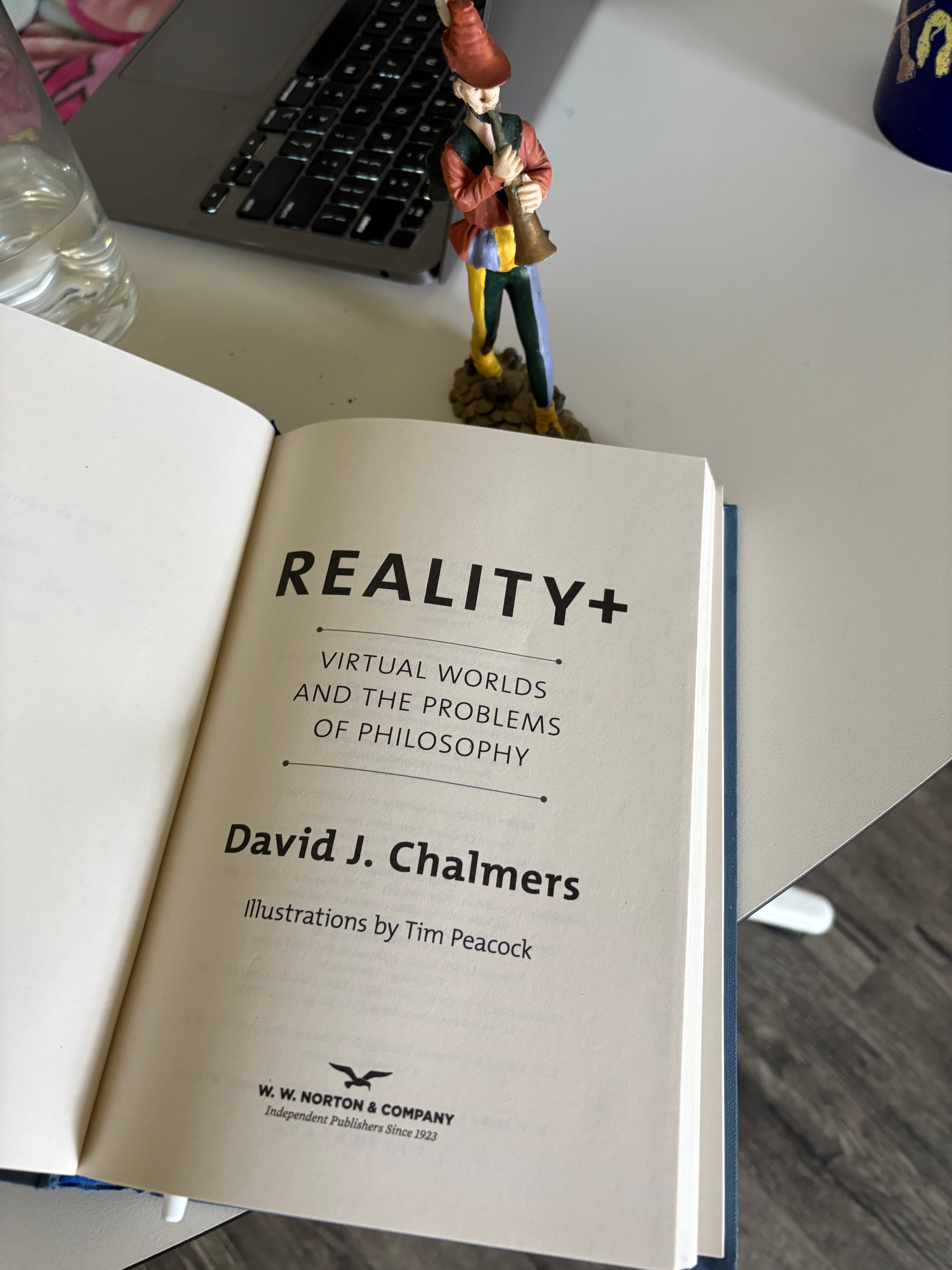
The philosopher David Chalmers argues in Reality + about the simulation hypothesis that if we are living in a simulation, it doesn’t make anything less real.
The train that I create in real life running down the tracks may be a visually represented computation of my brain processing information regarding light, sound, mechanoreception (our sense of vibration and spatial grounding), all the information filtered through my senses and creating an image of a train moving across the landscape. When I see a train, others see a different train. Scientists know that a flight of stairs looks taller and higher to those who hate stairs than for those who love climbing up stairs. They are represented as distinct images. The train I see is not a “real” image, but it doesn’t make it any less Real. Like Dumbledore says to Harry, "Of course it is happening inside your head, Harry, but why on earth should that mean that it is not real?"
Just because we’re computationally creating the train we see in real life, if I stand in front of it (to use an example I got from Donald Hoffman), I will be torn to pieces. I will die. It is real, even if it’s simulated.
Today I’m thinking of the train I created with my dad’s ET-3400, and I know it was simulated, but I also know that it’s real, because when I think of it and the code I entered into the keyboard to fabricate it, I’m getting a glimpse of how things work.