

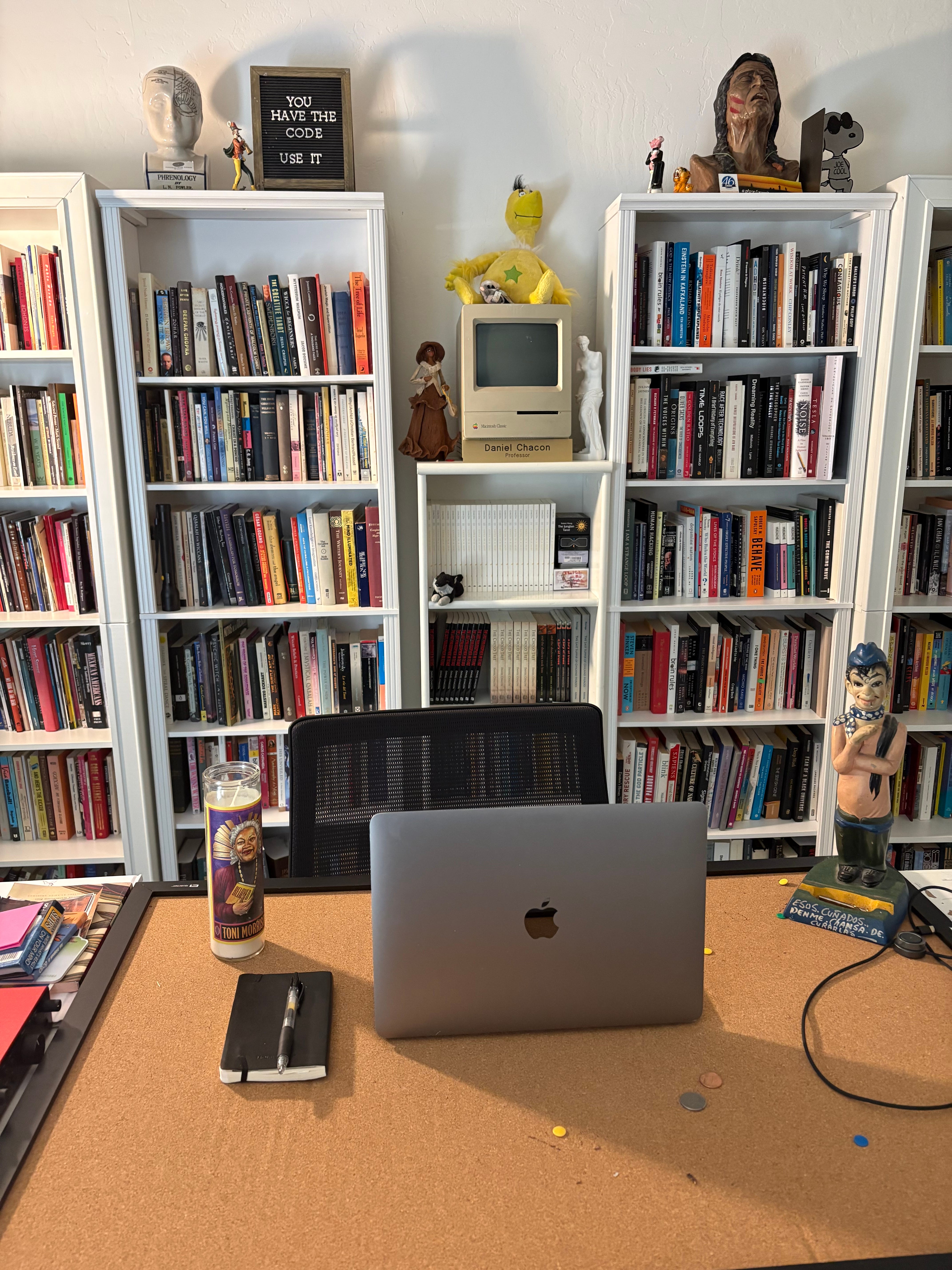
I wake up early, when it’s still dark outside, and I go to my office and read and write. Most days, I only have an hour and a half to do this, because I have to wake up my daughter and get her ready for school, and make coffee and lunch for my wife, but almost every day, I fuck up.
I’ll be writing– and it doesn’t even matter about what– or what genre, I might be handwriting in a notebook, but I suddenly look at my clock and realize I lost track of time and it’s time for me to wake up my daughter.
I lose myself in the writing, and it feels good, like I’m about to discover something, or something wonderful is about to happen, or something wonderful did happen and I just need to find out what it was.
We all know that people take drugs from alcohol to heroin because they releases dopamine, which is not the pleasure hormone, but is the anticipation-of-pleasure hormone. Dopamine is your physiological system telling you that something good is about to happen.
For the poet something beautiful is about to take place in the poem, maybe something ineffable.
This is the Flow State, or the Writer’s High.
I’m writing and so focused on the work, so deeply inside of the imaginary world that I leave my body behind, and when I return to it, more time has passed than I realized, sometimes hours.
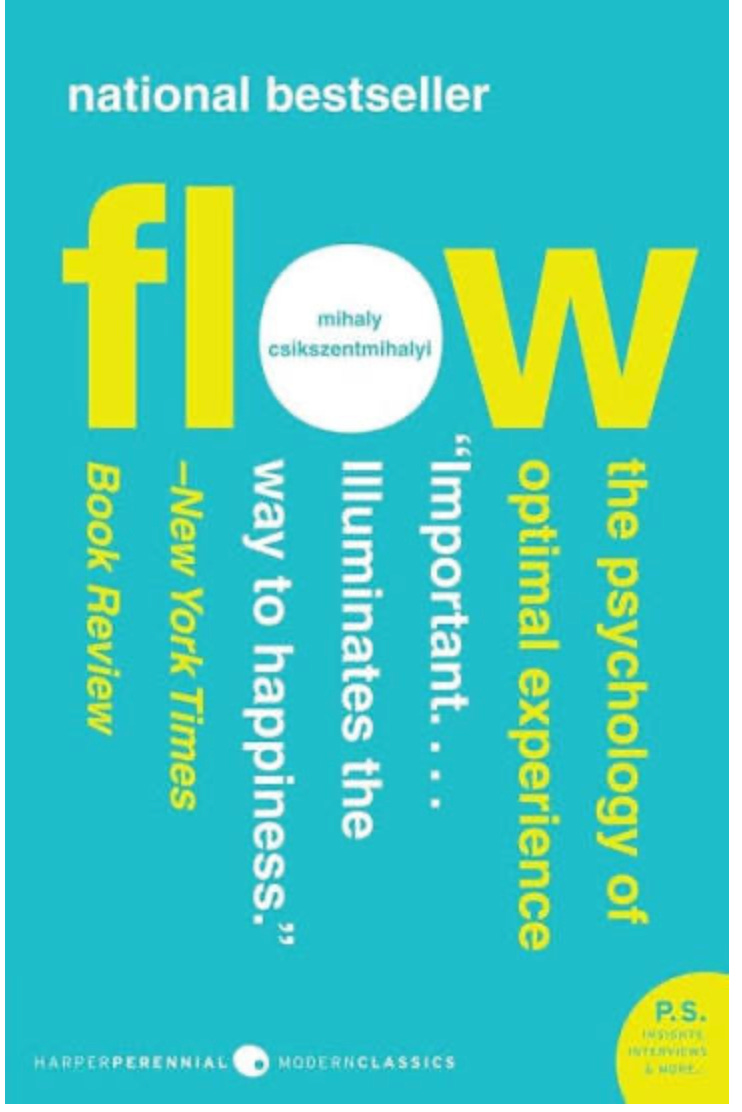
The definition of Flow by Mihaly Csikszentmihalyi is an optimal state of consciousness where a person is completely absorbed, focused, and deeply involved in an activity.
This happens to creative writers.
When you snap out of it and you reenter the “Real world” you might be hungry, or late to a class or have to rush to get your kid ready for school.
But there’s a problem. For many of us literary creators, it doesn’t happen enough, or when it happens, we feel lucky, because it may not happen again for a while.
We’re busy with the things we have to do, some of us battle with self-doubt, or we have begun to outsource our creativity to technology, so it becomes harder to have those moments, and writing more often feels like work that you don’t want to do.
Obviously, I get the term Writer’s High from the runner’s high, which is the most famous cousin of the Flow state, when you’re running for an extended period of time and then suddenly–swoosh– you just feel high, like your gummy kicked in.
Your body has no weight. You’re floating. You’re happy. Although we have been told this is because of endorphins, the feel-good hormone, it has more to do with endocannabinoids invading your bloodstream and brain, the chemical that hits the same receptors as the THC in your gummies.
I’ve never experienced the runner’s high, but I experience the Writer’s High every morning, with hardly any exception, except for if I ate too much bad food the night before and my body keeps pulling me back down to earth.
I’m an old writer. I’ve been doing this for decades. I’ve done my Gladwell’s ten thousand hours, and it wasn’t easy getting to this point. I used to wait for the muse, hope that I would have these moments. But now I don’t have to do that, and neither do you.
There are protocols and exercises that will help you reach the Writer’s High every day, three times a day if possible.
But it’s work. For athletes, the runner’s high usually kicks in after 30 minutes of running, maybe 40. You cannot just start running and immediately feel the high, otherwise everybody would do it. Pot dealers would go out of business.
Your body needs to be trained.
Same thing with the Writer’s High: you need to be trained, to build your craft muscles. If you don’t know your craft, if you’re not always reading amazing writing, even if you do experience Flow, it may not access the creative space where poets want to linger.
You need to know your craft. You need to read, and you need to study others that have come before you.
To recapture that Flow state can be hard, and new writers who don’t get there tell themselves that they have writer’s block or lack of inspiration.
You need to study poetry, fiction, creative nonfiction, whatever it is you’re writing. You need to be able to understand how it’s done.
You need to know the craft to create the magick.
For me, the Writer’s High usually kicks in 20-30 minutes into the writing process, but sometimes it happens immediately.
We want to understand how it happens, so that we can evoke it, call it at will, welcome the spirit of creativity into our work, to evoke Lorca’s duende, to call the muses.
Different metaphorical systems explain the Flow state differently, but I found a few helpful ways to understand it, neuroscience and mysticism, or religion. You can understand it both as processes of your brain and a visitation by the muses.
Being visited by the muse –or the spirit–or the duende–are different ways of saying Flow, and the different types of muses depend on what your body is doing while you are entering the Flow state. But Flow is a physiological state. It’s a function of being human. That doesn’t mean it’s not spiritual, but it can be explained physiologically, which means you can prepare your body for it.
What’s going on in the brain during Flow?
Writers think in terms of metaphorical structure. Everything we write is metaphor whether we like it or not. If we write about a town or city, everything in that city becomes a metaphorical possibility for the reader, whether we’re aware of it or not.
So let’s look at a brain metaphor that neuroscientists of the past have left for us.
Remember, this is only metaphor.
The triune brain.
It says that humans have three brains that evolved over time.
The reptilian brain. This is associated with unconscious movement across the landscape, breathing, blood circulation. You can imagine a lizard running across the desert, climbing over rocks, going through little crevices. The lizard doesn’t have to think about every movement. It just does it.
This is the most ancient part of the brain.
The animal brain. This is the limbic system, the part of the brain that carries emotion that wants to fight, run, or fall in love. This part of the brain feels emotions.
The human brain. The prefrontal cortex, the decisionmaker, the part of the brain that you use when you don’t do something that you want to do because you know it’s not good for you. It’s also the part of the brain that tells your story, who you are, why you matter, etc.
During Flow, the animal brain, which consists of two very important parts, the hippocampus and the amygdala, dims its energy. The animal brain isn’t very active during Flow. This is kind of non-intuitive, because one would think the amygdala and the hippocampus would be the main players in the Writer’s High, the creation of poetry. But the animal brain tries to shut down.
The hippocampus is metaphorically where our memories are stored. If you’re in the state of Flow, and you’re not accessing your personal memories, yet you evoke poetic images, from where do they come? You bypass your personal storage of memories and must be accessing memories (images, rhythms) that belong to a larger structure, a larger consciousness. In Mystic terms, you are getting a glimpse beyond the veil, a vision into another world, or in theoretical physics, a glimpse into the Multiverse.
The amygdala, the other main part of the animal brain, is the emotional center of your experience and has often been called the fear center. This dims too while you’re in the Writer’s High. This also seems counterintuitive. When we write poetry, aren’t we writing from the emotional center?
Not when you’re in Flow, but if you think about it, it makes sense. Many people will not write the scenes that need to be written because they’re afraid, or they don’t want to take risks, or they don’t think they’re good enough. When you are in the Writer’s High, you lose those fears, which means you can exit your own autobiography. You are a soul free to wander wherever the language leads you.
This leads to the most important part of the neuroscience regarding Flow. The prefrontal cortex virtually turns off. You’re not human when you write!
The prefrontal cortex has been called the CEO of the brain– to use a capitalistic metaphor. I prefer to call it the Abuelos of the brain, because there are two sides, the left and the right, metaphorical male and female, logical brain and the creative brain, and they are connected by this thing called the Corpus Callosum, which gives the brain the illusion that they are one unit, one brain, even though they are two. All those clichés about left brain/ right brain are rooted in this idea that the brain has two distinct identities. In fact, if you cut the part that joins them together, and this has been done in surgery, you could have one side of the brain that believes in God while the other side is an atheist.
I reject the term CEO of the brain, and as I said, I call the prefrontal cortex a they, and they are abuelos like in a Mexican family. They carry the name of the family. They create the story. They tell you who you are. They tell you what you should believe. They guilt you into doing the right thing even when you want to do the opposite. When you are in the state of Flow, the abuelos are not allowed in the room. You lose your sense of self.
Now here’s the stunning thing. If the human brain which is logical and the animal brain which is passionate and emotional dim during the state of Flow, what part of your brain is active?
Enter the lizard.
During Flow the reptilian brain, especially the basal ganglia, takes over. Remember this is the most ancient part of your brain, responsible for how you move across an uneven landscape, your breathing, your blood flow. During Flow this part of your brain takes over. It understands rhythm, movement, trajectories.
If you have studied martial arts all your life and you get into Flow during a fight, this is the part of the brain that takes over. I imagine Bruce Lee experienced this often. If you have practiced basketball all your life and you are in Flow, you move like magic. In this state the abuelos have no voice in the decisions your body makes.
If poetry is visceral, then poetry written during the Writer’s High is optimal.
Physics and Mysticism
Sir Roger Penrose, one of the most accomplished and influential physicists of the last two generations identifies three worlds within which human beings interact.
The physical world. Where your body is. The earth, the landscape.
The mental world. Your thoughts, your identity, your belief systems.
And the mathematical/platonic world. This is the world that can be discovered by mathematicians, physicists, poets, and it consists of patterns that exist with or without you, images that are fundamental to collective consciousness. This is the world you can access during Flow.
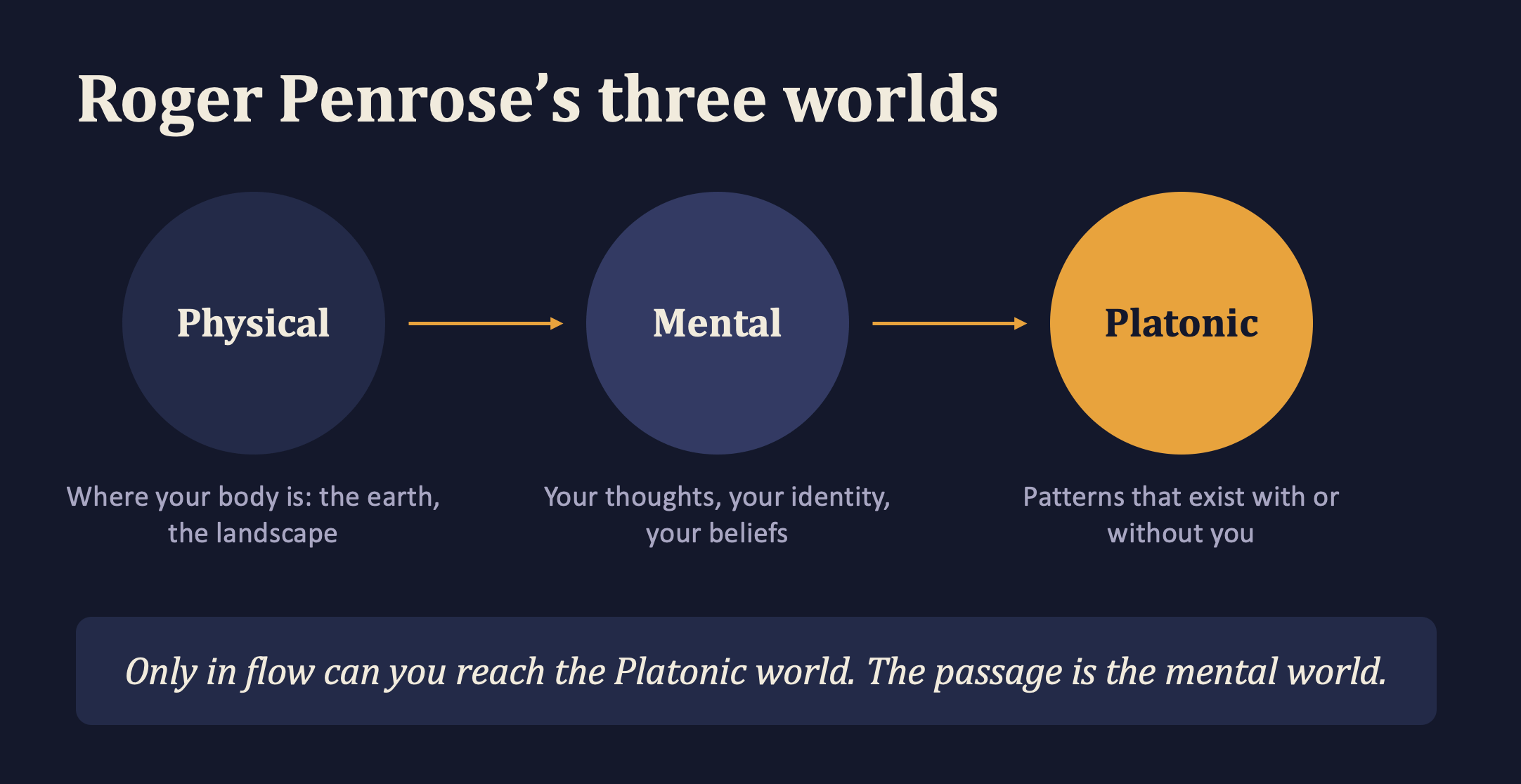
The wormhole into this realm is the mental world, your mind. Writers have the kind of mind that allows for deep focus; if not, they will never make it into the platonic world. You might get glimpses, like we all do, but you won’t be able to linger there. You need to develop the mind. You need to be cognitively fit, and there are many ways that you can ensure this, including reading two hours a day, having conversations, exercise, and writing writing writing.
Mystic systems distinguish worlds that parallel Penrose’s three. For example, if you look at the worlds of Kabbalah, it’s clear that there are correspondences to the those of Penrose. These different worlds exist in all Mystic systems, and it is the root of one of the most fundamental principles of mysticism and the occult, as above, so below.
No matter what system you come from, whether it’s science or mysticism, the state of Flow is when you leave your body and enter another world.
The world you enter is real!
It exists, and it has been visited by poets and physicists and dreamers and mystics for generations of human experience.
Newton didn’t create the laws of motion, he noticed them, and the math was there with or without him. In Flow you have access to the platonic world, which is to say, patterns.
You have access to pure mind, which is pattern recognition.
The universe is full of patterns, weather patterns, sound waves, biological patterns, linguistic patterns, patterns everywhere, but most of us react to those patterns rooted in our own story, so that rain means, Oh shit! I got to get an umbrella.
In the state of Flow, you’re connected to the world of patterns, so you can not only recognize them, but are able to use them, experience them, ride on the back of one.
In occult terms, you are entering into the astral plane. In Kabbalah you are entering into Yetzirah, the place where the gods are given their form, their image.
To start the practice of being able to experience the Writer’s High every day, to be able to call the muses when you needs uses them, you can start with this:
Put aside an hour and a half every day to read a novel, a great book of poems, anything that will allow you to leave yourself behind and enter an imaginative world. You must be able to get lost in Books. There is an axiom among creative writers often attributed to Flanner O’Connor: If you are not surprised by what happens in your work, the reader won’t be surprised.
But this is also true: If you can’t get lost in another book, if you can’t experience Flow while you’re reading, to leave yourself behind and be totally absorbed in the world of the book, you won’t be able to re-create that experience for your reader.
And when you read for an hour and a half or two hours a day, do not have your phone on. Just be there. As a bonus for doing this, neuroscientists tell us that reading for two hours a day will grow new neurons and expand your cognitive and creative abilities. If you want to reach the Writer’s High, this is a good start.
In the next entry, I’ll provide more protocols and talk about another state of consciousness that writers can evoke to enter other worlds. Hypnagogia.