
THE WAY OF THE COOKIE
Magick and Tarot in Madrid

I walked into the seminar room five minutes early to set up, but the chairs around the table were already full—each one occupied by a Spanish writer: first-year MFA students at the prestigious Escuela de Escritores, located in Malasaña, Madrid’s cool, artsy neighborhood. When they all turned toward me, knowing who I was, I felt a surge of Imposter-Syndrome, and an inner voice squeaked, What the hell is a Chicano doing giving a workshop to Spaniards – in their own city? I’m a joke! I can’t do this! I felt myself beginning to crumble.
When I hear that voice (it’s been with me all my life), I try to convert the energy that fuels self-sabotage and use it to power more useful drives, like teaching, the reason I was there: To give a workshop and lecture called “Tarot, Magick, and the Imaginal Realms.”
It’s a workshop I’ve done before, in Colombia, the Netherlands, Mexico. It’s a two-hour thought experiment that use in an MFA seminar called “The Writer and the Occult.” The workshop is designed to help writers induce the flow state, the Writer’s High, through the use of protocols rooted in physiology and the occult. Oftentimes new writers get stuck on their ideas and they find themselves unable to experience the necessary flow that needs to happen on a first draft. Only when we’re writing and time disappears do we enter into the imaginal realms, that is, cognitive-imaginative spaces that exist outside of our space-time. Call it the Astral plane, the Mundus Imaginalis; call it Yesod on the Cabala Tree of Life; the Collective unconscious; or even the mathematical world, but this is a real place. Creative people go there and interact with meaningful symbols and energies outside of their conscious experience, what Antonio Damasio describes as ‘homeostatic feelings’—bodily, preverbal sensations that arise before conscious thought, and which form the basis of intuition and meaning‑making.
When writers claim to have writer’s block, what they mean is they’re not reaching the flow state, that writing is laborious. They have no ideas. Writing is like pulling teeth and so they fall into cliches, like that one.
They cannot enter into the imaginal.
But we don’t have to wait for the muse. We can release our intuition and follow it into the imaginary spaces. We can bypass the executive brain and drop into the “gut,” both literal and metaphorical, and we can enter into the forest of symbols Baudelaire writes about in his famous poem “Correspondences” about the ideas of Swedenborg. We must walk into the forest intuition-first, like children running into a field. You won’t be able to go very deeply if you try to make sense of every symbol along the way, if you can’t keep your brain quiet. Ed Hirsch plays with this idea in his poem “I'm Going to Start Living Like a Mystic,” where the poet take’s a flaneur’s walk and brings interpretation to the symbols along the way, never allowing for the experience of undifferentiated energy. It’s pretty funny.
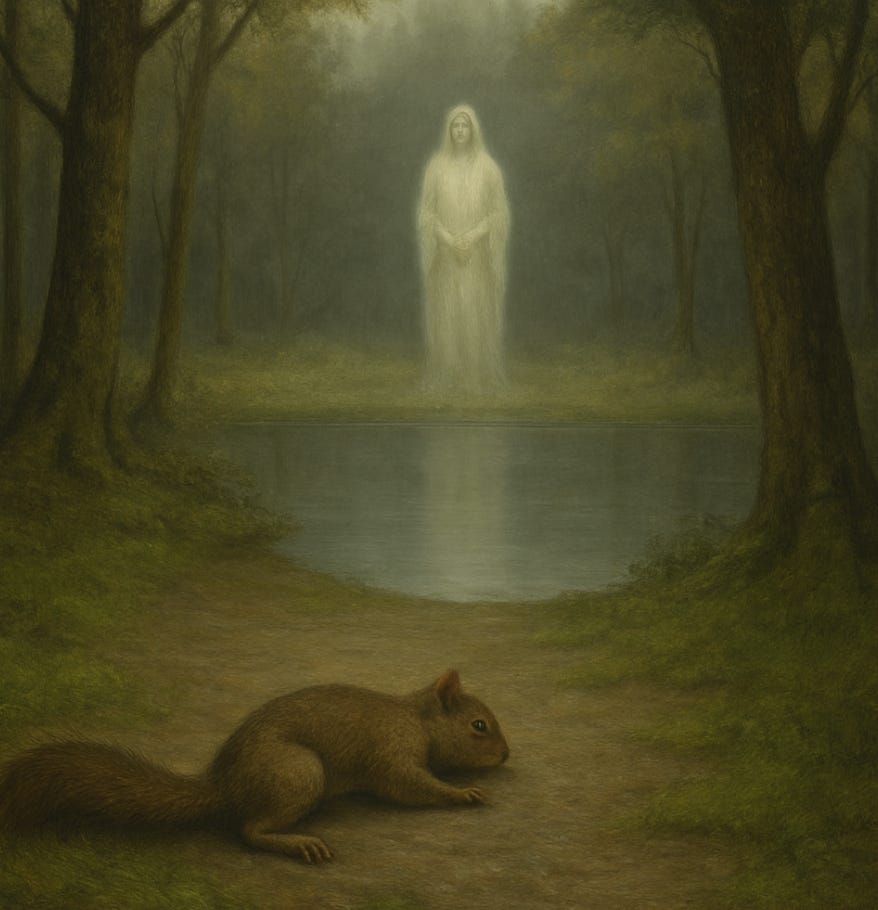
I will kneel on the track of a vanquished squirrel
and stare into a blank pond for the figure of Sophia.
Ever since Csikszentmihaly’s influential book Flow, lay people have known that when you reach that state –the runner’s high, the writer’s high–your physiology dampens your dorsolateral prefrontal cortex, and in the process you lose the story of yourself, the “I” and the ideas that you carry around like rocks. If you slap meaning on everything you see in the 'forest of symbols,' you can’t go very deeply—because you’re handing the experience over to the executive brain. Only when you are unfettered by ego can you enter into the forest and explore, and you can make choices based on intuitive guides, like language and music and mathematical elegance.
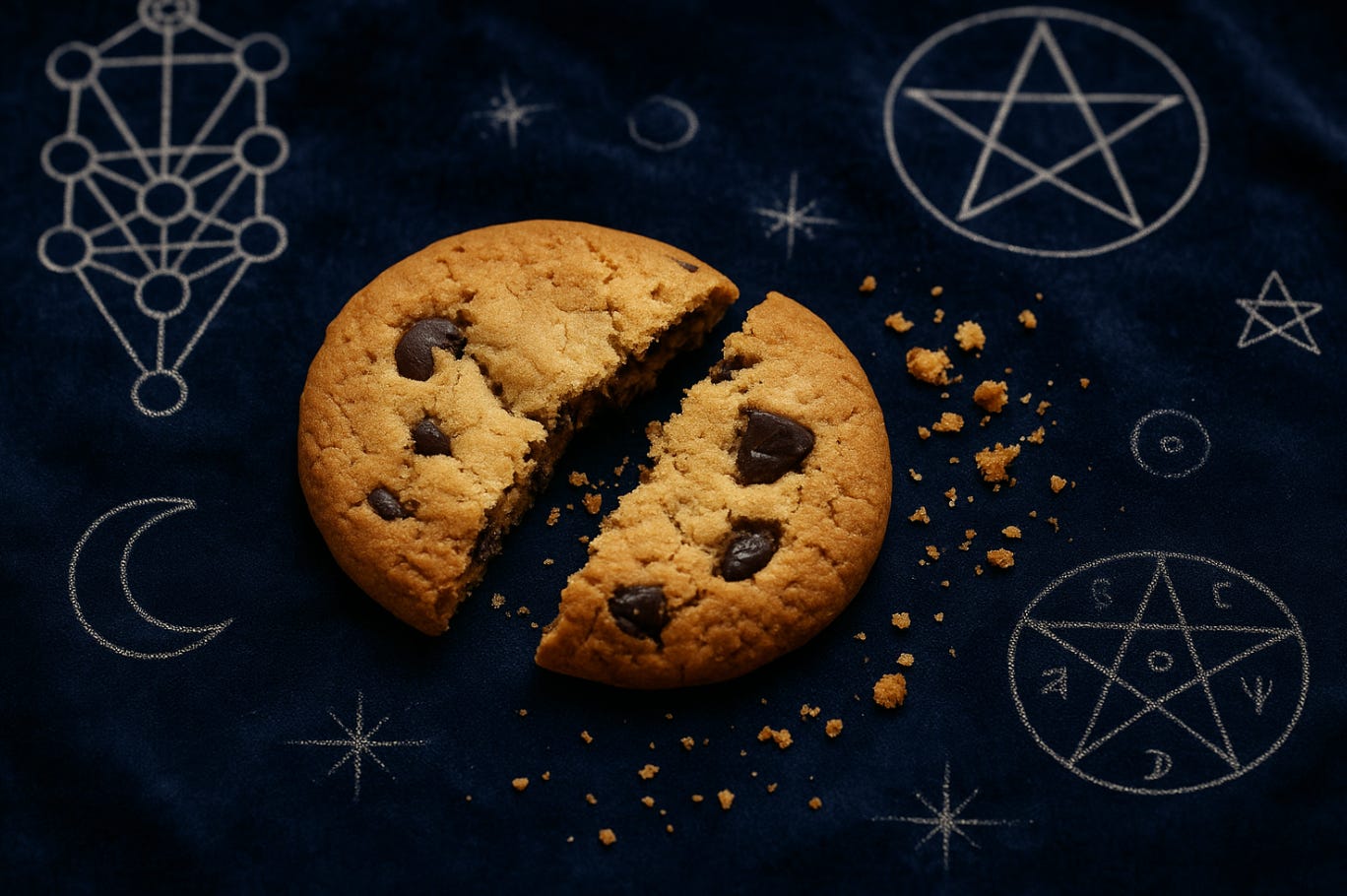
One of the ways to free your intuition is divination systems such as tarot cards, augury, lithomancy, and one I invented for the workshop, Cookiemancy, a divination system using broken cookies as symbols.
The MFA students at the Escuela seemed eager to get started, big smiles and eager eyes; and one woman at the end of the table sparked my Courteney Cox neuron[1], the pre-Friends version when she jumps on stage in the Springsteen video. She had black hair cut short with big eyes and a friendly smile that just wanted to let me know I was welcome and that the students were eager to hear what I had to say. I took my position at the end of the table and started to hook up my laptop for the PowerPoint, but the woman on my right kept looking at me with squinted eyes and a frown, as if she had a question, until finally she asked, Isn’t Chacon a Mexican name? You don’t talk like a Mexican!
Meaning my Spanish sucks.
She wore a light brown shirt that matched her hair color, a woman in her mid 40s, with wide green, speculative eyes. Her name was Laura[2], and she is important for this story about the Way of the Cookie.
I’m a Chicano, I said, and proceeded to explain to the Spaniards what that means.
We started the workshop with a three-card draw from the Waite-Smith deck.
Our reading was about how the workshop might unfold.
The first card represented our collective energy, our Egregore, an idea rooted in Enochian magick that tells us when you walk into a group, the energy you feel is an actual entity, a demon created by the collective spirit of the room. As an entity, it has an independent will. The first card was our Egregore, our demon.
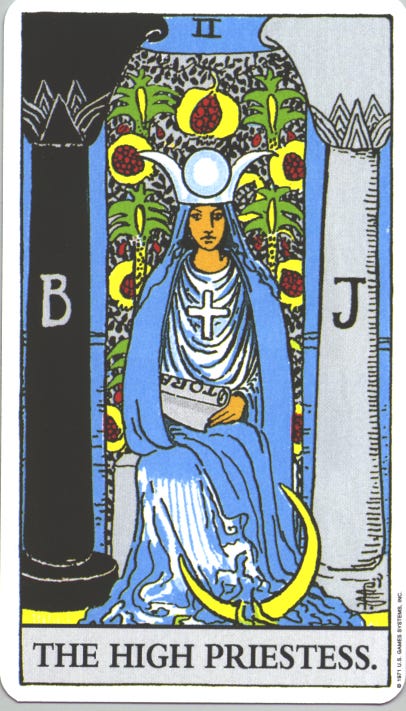
Or our Angel, because sometimes the energy in the room is positive, like today, everybody so eager and open. Except for maybe Laura, who kept making remarks and laughing at her own jokes.
The second card represented what they wanted from the workshop, that is, specifically in relation to what they wanted to write for their major project, a novel, stories, poems, essays. As first-year MFA students, this was the semester that they needed to figure out what book they’re going to write and submit for publication when they graduate.
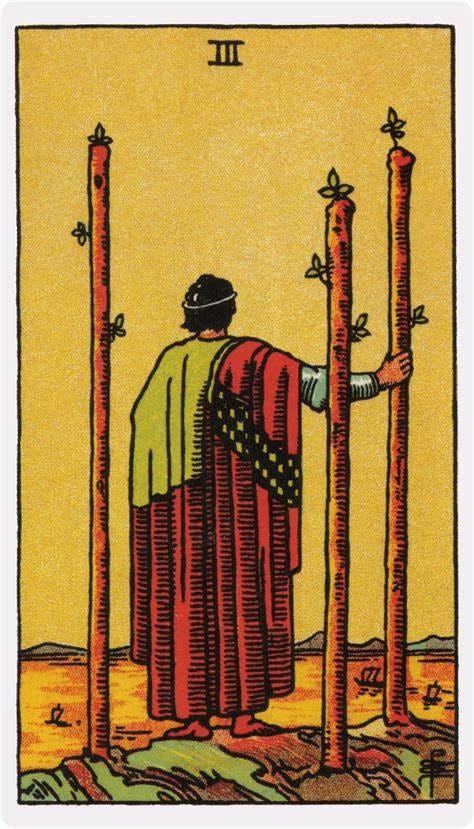
The third card represented an unexpected result of the workshop, something that they did not expect was possible. I don’t exactly remember what the first two cards were, but I remember the third card we drew, the one that represented what could happen in the workshop, an unexpected result.
It was the hanged man.
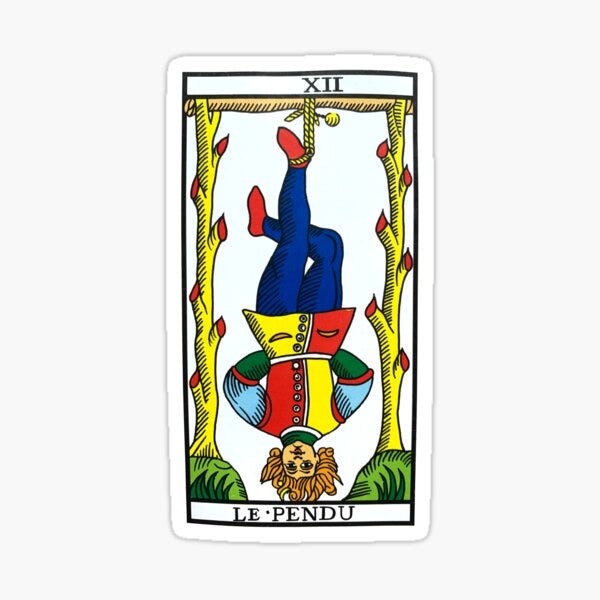
It made sense to all of us. This card was telling us that one of the unexpected results of being together that day might be to begin to see the world upside down, from a new perspective, to see things the way that most people cannot see. Of course, you could get a bunch of tarot practitioners to argue about the “true” meaning of the hanged man, their unbending interpretation, but the fundamental principal for writers to understand is that cards mean nothing.
The card has no power.
We have the power to connect to archetype and allow the image to help us scaffold our intuition. Most people in that room, because the workshop was about tarot and magic, believed that it could help them to see things a little bit differently. The guy who looked like a British actor from the BBC Sherlock Holmes series even had his tarot cards in front of him, two decks. We all knew that an unexpected result of our time together could shift our perspective, even if only temporary.
From then on we talked about some fundamental principles of the occult and their correspondence to the body, and we did a breathing exercise that can help us reach a quasi-hypnagogic state, one of the ways that our body signals that we’re about to enter into the imaginal.
But what about the cookies?
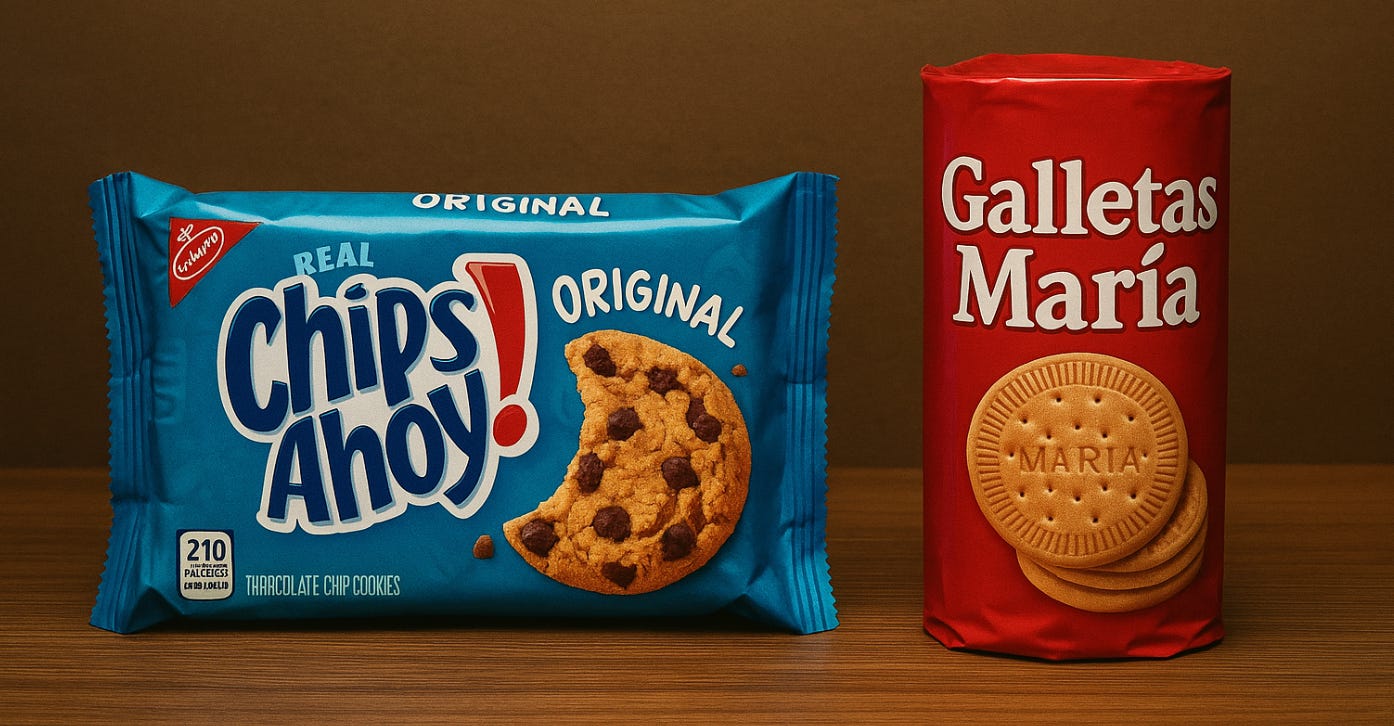
I pulled out two packages, Chips Ahoy, which I wanted to represent the good old USA and a package of Galletas María, Spanish cookies you can find in any Spanish grocery store.
I put both packages of cookies on the table. Everyone looks at them, maybe wondering why I would pull out bags of cookies, and Laura reaches for a bag and wants to open it, thinking that I had brought the cookies for them, but I said, No please. Those cookies are like tarot cards, I said. We are about to use them to figure out what we need to do with our final project, our novel or collection of stories.
You want to know what you should write next? The best person to ask is you, but not the you that thinks it’s in charge. Not the prefrontal cortex-you.
Maybe we say, That’s the way the cookie crumbles! Because there is something archetypal about the image of a broken cookie. So we are going to ask the cookies about our MFA project.
The cookies know!
I asked for a volunteer, someone who had a question about their creative project.
Laura’s hand went up first.
I thought maybe she was just eager to get a cookie and I pretended like I didn’t see her and looked around hoping maybe Courtney Cox would hold up her hand up or the guy who brought his own tarot cards, or Valeria, who had shared her writing exercise with us and left our mouths dropped open. For this to work, we needed someone who was willing to go with the process, to explore the possibilities.
But no.
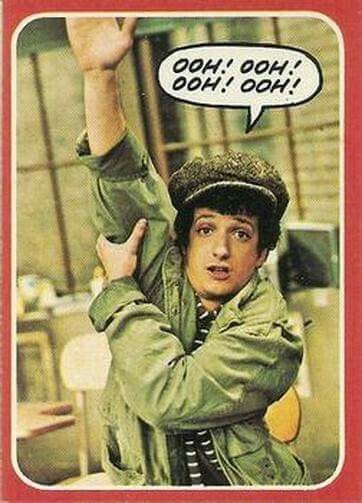
Laura kept her hand up, like Horshack on Welcome Back Kotter, so I had no choice but to read her cookies.
And now, I am so grateful that it was her.
To start the cookie reading, I held up both bags and said, USA Cookies? Or Spanish cookies?
Can you guess which bag Laura chose, Chips Ahoy or María??
(I don’t want my Substack articles to be too long, because I know we have very little time to read on our devices before the next notification ping, so I’m going to end Part One here. If you’re interested in reading what happened with the cookies, email me or send me a quick note, and I’ll send you part 2.)
[1] See The Forgetting Machine by neurologist Rodrigo Quian Quiroga, as the Cox metaphor is in response to his discovery of the Jenifer Aniston Neuron, the fact that anybody who has ever heard of Jennifer Aniston has a particular neuron in their brain that sparks a network of neurons related to all things Jennifer Aniston. When I saw that woman at the end of the table and I remembered Courtney Cox, I projected a cognitive screen over reality, and she may in fact look nothing like Courtney Cox from the Bruce Springsteen video. It’s just how I encoded my memory, and in fact, the man across from her, to me, looked like a British actor whose name I can’t remember, but who appeared on the BBC Sherlock Holmes series.
[2] Laura, if you ever read this, which is possible since I gave the writers my Substack info, you might be saying to yourself, My name isn’t Laura! I wasn’t wearing brown. I’m not in my mid 40s.” And I just want to apologize for the blurry facts. I didn’t take a picture or record the audio, although I had planned to, and usually I do. But something made me forget to record any of it. I remember leaving the workshop and then remembering to take at least a picture of the group, and I was so upset that I had forgotten. But now I’m glad I didn’t take a picture or even write down facts in my notebook, because to piece it together now in El Paso, TX relies on memory, which is imagination, which Einstein famously says is more important than knowledge.
So awesome 😎👍 !!! This is the epitome of our own Ancestral roots and the ancestors coming through, loud & clear - in our speaking different languages, our spirits and souls, and in putting the words onto the paper !!! Such a blessing !!! xo 🥰 📜 🙏 💟 🥰💗 🙏 📚🎉