

When a writer focuses on her landscape, whether it’s a physical setting that appears in a story or a rhythmically-inspired spinning landscape in poetry or prose, she uses one of the five forces of the universe: the imagination.
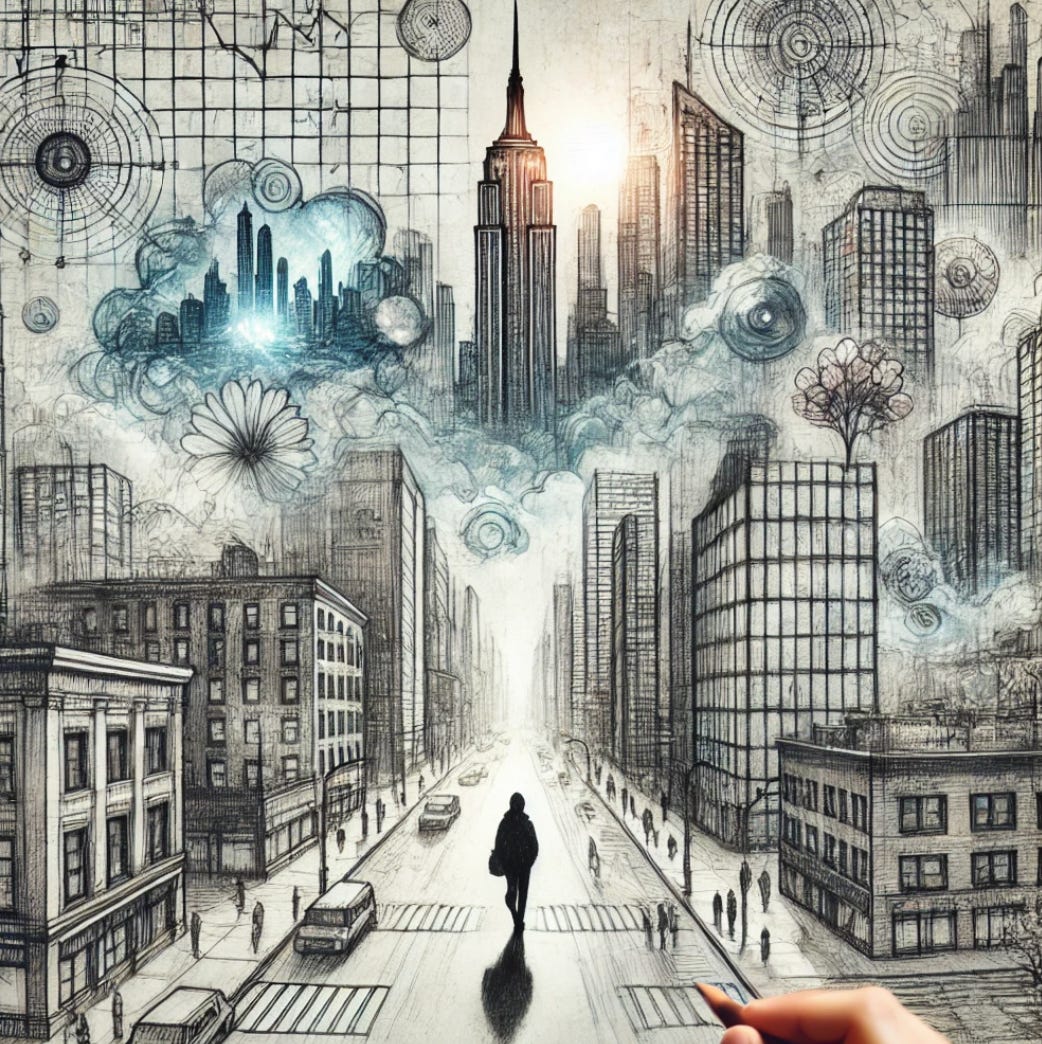
Basic physics says there are four forces, gravity, electromagnetism, and the strong and weak nuclear forces; but there is a force that pulls them all together, Imagination.
Imagination unites the forces.
Cosmology, based on Einstein’s relativity theories, and quantum mechanics, based on Heisenberg’s uncertainty principle, will tell you the same thing:
The observer creates what we think of as real.
Einstein tells us that time is relative and has meaning only according to the observer. But not only that, he also tells us --and this is something that most people will not accept unless you're a writer or a physicist, --that the size or length of matter depends upon the observer and their velocity, not the matter itself. He calls this the Lorentz contraction, a relativistic effect with mathematical precision, and it seems to reveal how our imaginations can be responsible for the size of matter and how we transpose maps over the universe.
Quantum mechanics tells us that matter isn’t even there. It’s not solid. It can’t even be located without you to observe it.
We observe reality according to our perception of the world; that is, like an atom, we can’t be trusted. We make up everything.
This is well-known.
But here's the exciting thing that writers know, or should know:
When we imagine the world to be a particular way, we get constant confirmations that our imagination is indeed how the world works. A basic example is a writer who is so absorbed in writing a novel that they enter into it over and over again, every day. But then this happens (and I'm sure many writers can confirm this): when they leave the imaginary world and walk out into what we think of as the real world, that world provides the writer with details and answers that deepen the work, as if the universe was cowriting the novel. This happened to me when I took a year off from the university to write my novel in Buenos Aires, and every day after writing for hours I would enter into the city and find the details that the novel needed. During that year I even met people who embodied the same spirit as the characters in my novel or whose spirit I released into my novel. After a while it was hard to distinguish between the world of the novel and the city on the other side of my door.
The world is shaped by our imagination.
This is the basic idea behind Think and Grow Rich or the Law of Attraction or putting intentions out into the world. When we are focused on what we want and we truly believe we will get it, the landscape will populate itself with what we seek, because our brains filter out all other available information.
Even more stunning is what neuroscientists tell us about what we literally see. We have a tiny part of our eye called the fovea, which is slightly bigger than the period at the end of this sentence. This is the part of the eye that can focus, it’s high res, like a portrait photograph of a stamen. Our eyes can only see the stamen.

Everything else we think we see, the petals of the flower, the mountains where the flower grows, the tree-line, are created by our imagination based on memory and cognitive maps. We create all we see but that tiny spot in the fovea.
According to Kabbalah, all that we see and think of as the real world is merely one percent of reality. If you want to see the rest, or get a glimpse beyond the one percent, you need your imagination.
Here’s a sad matter:
If we are not aware that we use our imagination to create reality, if we think there is such a thing as an objective world, the world collapses into our unconscious preoccupations. The world shrinks in possibility. We are creating reality in the Default Mode of Consciousness.
If we imagine that time is our enemy, always working against us, always running out and making us late, we rush through the landscape, down the freeway, swerving in and out of cars to move faster. We encounter so many frustrating obstacles, and we are impatient with or don’t even notice the things that are out there, other cars, a stalled truck on the side of the road, a cat in a window.
I loved my father, and if he had been able to have the time to feed his passion for mathematics and engineering, he could've been a brilliant, successful man, but long hours of work got in his way, diabetes, addictions. As he aged, his brain began to atrophy and his world became smaller and smaller. He was convinced that everybody was out to get him, everybody, even those he could have loved instead of distrusted. This was the world that he lived in, and he was constantly getting ripped off.
He let men into his house to remove a wall, and he watched them like a scrooge, treated them like convicts, and he was convinced they were going to steal from him.
They stole from him. One of them took his check book and wrote checks for large amounts of cash that drained out his account. A lot of people took advantage of him, because that's the world he lived in.
And this is the essence of mystic experience, the human ability to focus so minutely on a belief that physical reality follows suit. This is the essence of being human, the ability to focus and allow our imagination to integrate the forces of the universe.
The writer then is somewhat of a magician, because this is what we’re good at. We can shape matter, time, and use language to create a reality the readers are willing to walk into.
To create a reality that readers experience as real (because it is real).
When we are absorbed in reading a novel, those moments when we feel like we’re actually there, or the very least like a movie is playing in our head, or when we read a beautiful poem and the images and the rhythms take us on a swirl of metaphysical travel, we are using our imagination to ride along. We are connecting to another reality.
Unfortunately, there are many “creative” writers who use very little imagination.
They have access to thoughts, and sometimes they are big, important thoughts, but because they are only thoughts, they may not have access to a more expansive imagination, they may not be able to go beyond the one percent.
They lack what Flannery O’Connor calls anagogical vision. “The kind of vision the fiction writer needs to have, or to develop, in order to increase the meaning of his story. . . the kind of vision that is able to see different levels of reality in one image or one situation.”