

I don't believe that the mind/body duality is anything more than a metaphor to help us understand the different mechanisms of our organism. Like all dualities, mind and body are basic tiles that begin to create our understanding of a complex system, which we are.
But dualities are not real. Only unity is real.
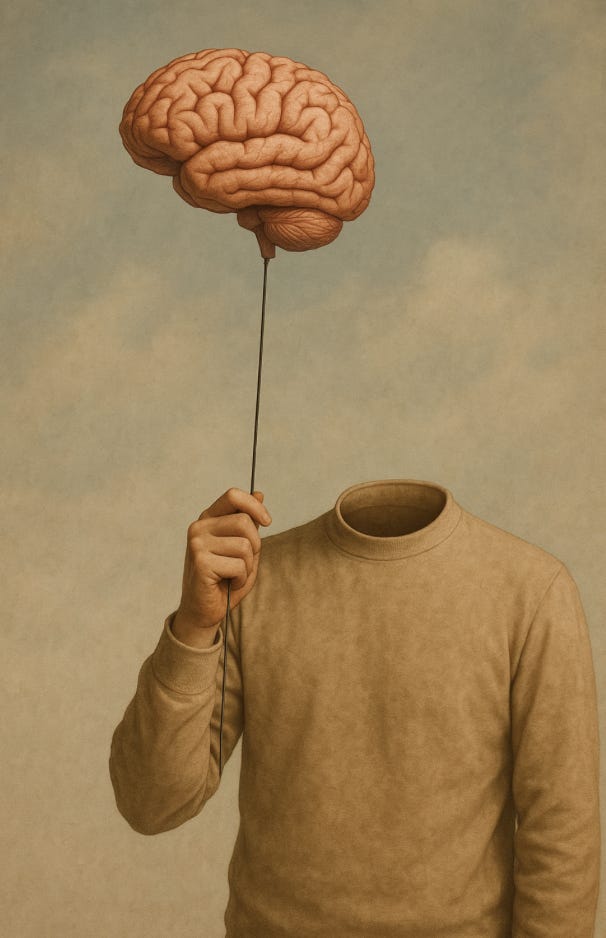
There is no mind without the body. The brain-in-a-vat separated from the body is a metaphor that helps us to understand our parts, and the brain alone will never write great poetry or music, not without the body.
Later, I will do an article about Alvin Lucier, how his brain continues to “compose” music after his death, an idea that is trending right now. This experiment is not a brain alone in a jar, but one with electrical inputs and chemicals which will have an effect on how the matter of the detached brain puts out signals. There is no scientific proof that a brain doesn’t need the body for creative pursuits.
The fact is, if we were able to write beautiful poetry or music with just our brain, if poetry wasn’t visceral but was 100 percent cerebral, then we would have to admit that Large Language Models like ChatGPT can write better poetry than us. After all, it has a much larger linguistic training database than we do, and for every word it presents, the possible word that may follow (the number of tokens) is much larger than those that can occur to a single human brain. They call LLMs neural networks because they do not need a body to contribute to the creative process, just the brain.
But it’s also why they are not as good as us.
Basic dualities, like mind and body, are a good way for us to begin to understand a complex system, but to believe them as real is to prevent creativity and imagination, which writers need. Lately I’m kind of being trolled for a comment I left about binary gender, responding to Richard Dawkin’s assertive scientific “fact” that they’re only male and female. Inspired by the brilliant novel by Emma Pérez, Testimony of a Shifter,
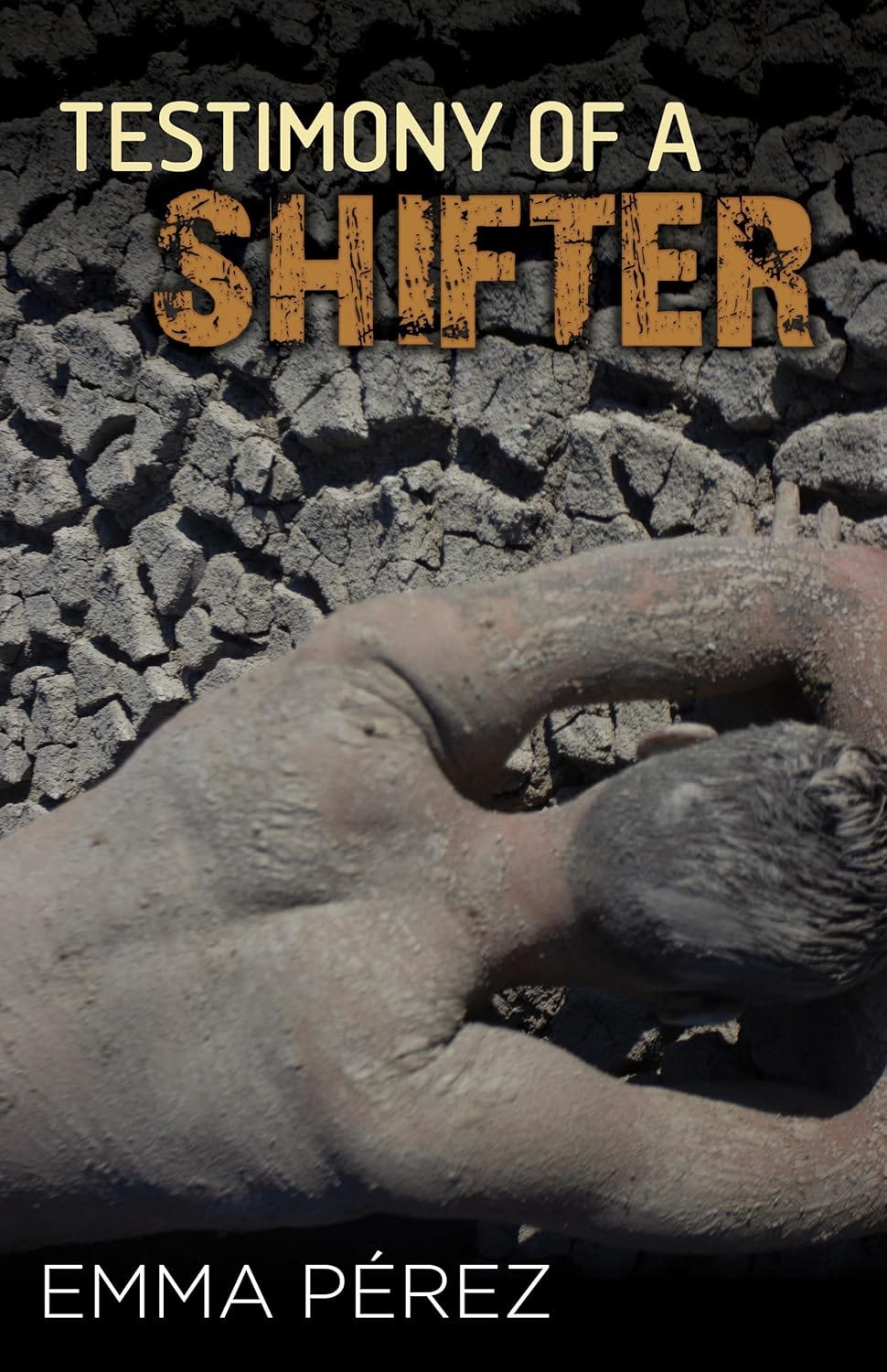
I raised the possibility that humans are evolving creatures, and as we move away from the need to procreate, our organisms may change. Some people were so angry at my comment that they asked me if I thought I was smarter than Richard Dawkins. I was just trying to question the duality and come to the basic oneness of sexuality, but we begin to believe in our dualities as a philosophy and religion and science, and the comments I got from these people who believe in only male-female science were emotional and defensive.
Basic dualities are a means for us to understand a complex system, but it is very difficult for humans not to believe it as truth, fact, unchangeable.
So there has to be good-evil. There has to be man-woman. There has to be mind-body.
Stick with me for a little longer, and I can make my point.
When I was going through a divorce I felt very alone, especially on Saturdays, which I considered my Sabbath, my day of rest. I have honored the Sabbath for decades. Growing up a Catholic, Sunday was the Sabbath, but I chose Saturday, because Sunday was the day before I have to teach classes and I needed that day to prepare.
So on Saturdays I don’t work, but during the divorce, those long hours were the loneliest, saddest of days. I had friends, but I didn’t feel like I could call them on a Saturday, because they had families and I knew I would just bore them with the details of my divorce. On Saturdays, I would get in my car and drive around the city, go to malls, grocery stores, take walks downtown; and one time, on a whim, I stopped at a big Best Buy and looked through the discount racks of CDs and saw one by Bill Evans for $2.99. I had never even heard of him, but on the cover he was hunched over a piano and I loved solo piano. I bought it, put it in the CD Player in my car and drove around the city.
After hearing the first song that came up, “Peace Piece,” I was hooked.
Give it a listen.
For the next several months, every Saturday, I almost exclusively listened to that CD. I felt a connection to Bill Evans.
It wasn't until later I found out how erratic his life was, how he was a heroin and cocaine addict, and I didn’t know about how many people so close to him had killed themselves, and how that must have been a constant internal dialogue within him, to be or not to be, why not just end it?
“Peace Piece” is a musical expression of how the mind/body duality of some creative people can both cause and calm the pain, how the mind and body together are necessary for creative genius. Large language models will not be able to create works written better than those poets, fiction writers, creative writers, who are committed to their craft, and who are ultimately the models on which the AI systems are trained, because every creative, divergent thinker, lives between the tensions of the mind-body.
The mind hops all over the place, but the body is still the body, and it always pulls the mind back into its home, and at times the body can be the only source of peace. Think of the effect heroin must’ve had on Bill Evans, how it would calm his body, bring it back into itself, while it allowed his mind to hop all over the place without rules, with only a rhythm of voice and intense emotional experience.
The mind is consciousness, and it is housed by the body, and it interacts not only with its own homeostatic imperative, but to extrinsic factors as well, such as where you live, the weather, social pleasures and pains. ChatGPT doesn’t have this.
As the mind runs linguistic, musical, mathematical rhythms, it also organizes it into meaningful patterns, into an order that can express the complexities of living, or in the case of Bill Evans, can organize the horror of our own thoughts.
Many geniuses have been tormented by their thoughts.
And it is the body that provides relief.
Sometimes some artists need to induce the body to give the mind comfort, like drinking a lot or using heroin, or Adderall for scientists, but often times it could be a good meal or a good night’s sleep, or even a run in the mountains, and those times you are rooted in the body can allow the mind unfettered access to reality.
I can imagine that when Bill Evans shot up on heroin, his mind was released from the body, or at least the illusion existed that it was, and he would pound on the keys.
In “Peace Piece” the left hand doesn't know what the right hand is doing.
The left hand is the body.
The beating of the heart, the stability. Sleep.
There is nothing erratic about it.
The body keeps the artist rooted, whereas the mind, the left hand, all over the place, erratic, sometimes desperate as it screams and dances around unpredictably.
But the body keeps brining the mind back home.
This is peace.
We are at peace when we are one.
If you listen all the way through, you will hear towards the end, the music stops, and it seems like the last note will fade into silence until the track ends, but suddenly it begins again, for one note and only one note, like the last breath of life.