

For a writer, uncertainty—or negative capability—is a superpower. It’s what allows us to dwell in possibility, to explore beyond the known, to imagine and create freely, to surf the multiverse. Yet our devices erode this strength. How many people would consider leaving their phone behind for a walk through a forest or a city, or even their daily commute? It’s not just that we don’t want to be without our phones—our current economic and social systems are designed so that we can hardly engage without them. Phones are wallets, maps, lifelines, and being without one feels unthinkable and may not even be practical.
Besides, I can’t get rid of my phone! I love my daughter. What if she needs me?
I go to Madrid every summer to give a workshop, and my hosts in Madrid don’t give me keys to my apartment; they have me download an app or connect on WhatsApp so that I can unlock the doors. Like in many cities, almost everywhere you go, it’s much easier to tap your phone to pay for anything than it is to pull out money or start counting coins. Currency Exchange windows are fading into the past.
This constant connectivity makes the world predictable, stripping away the serendipity of interacting with the landscape. Human beings have an innate capacity for spatial and temporal navigation, a primal code that allows us to engage deeply with our surroundings. But as the digital world encroaches, we lose this skill. Augmented reality in the form of glasses offers extreme digital shortcuts—a virtual arrow on the literal sidewalk to guide your steps, or tools to change the lighting and saturation of your environment to suit your mood.
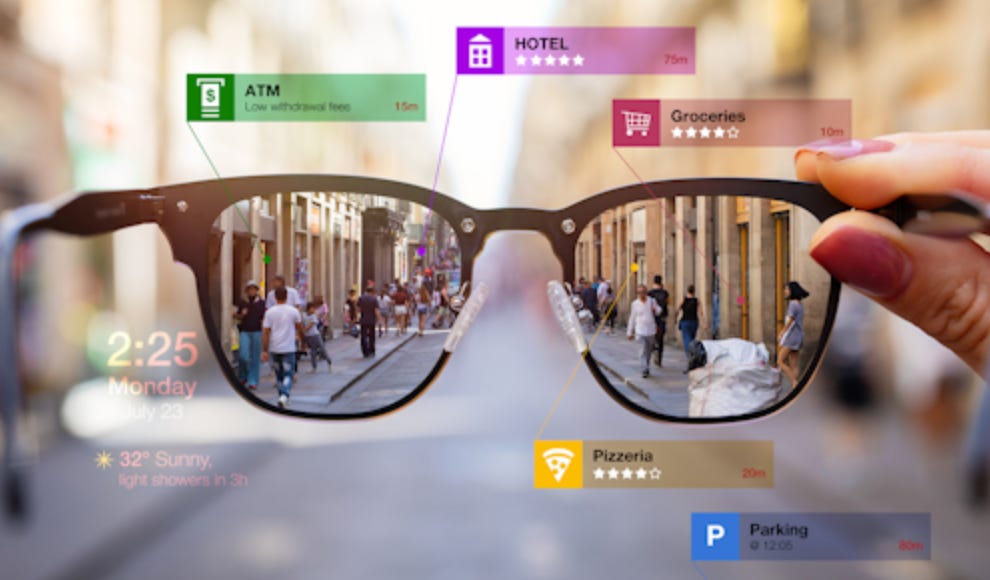
Smart glasses can even identify faces that tell you about passersby. You won’t have to make up stories about people you watch in the city. You could just look at their digital footprint. Soon, you may not even see the physical world as it is, but as a curated version of it tailored to the algorithmic preferences delivered by your smart glasses.
What’s most insidious is how emotions themselves are being curated. Sadness, for example, is a natural signal from the body—a message that something needs to change. But curated sadness? That’s a manipulation designed to provoke action: Click on the link. Buy this product. Follow this account.
For writers, resisting this curated existence is essential. Negative capability allows us to dwell in uncertainty and ambiguity, to forge our own emotional and philosophical paths, free from the influences of algorithms that seek to commodify our attention, our money, our very minds.
LOOKING FOR DUENDE
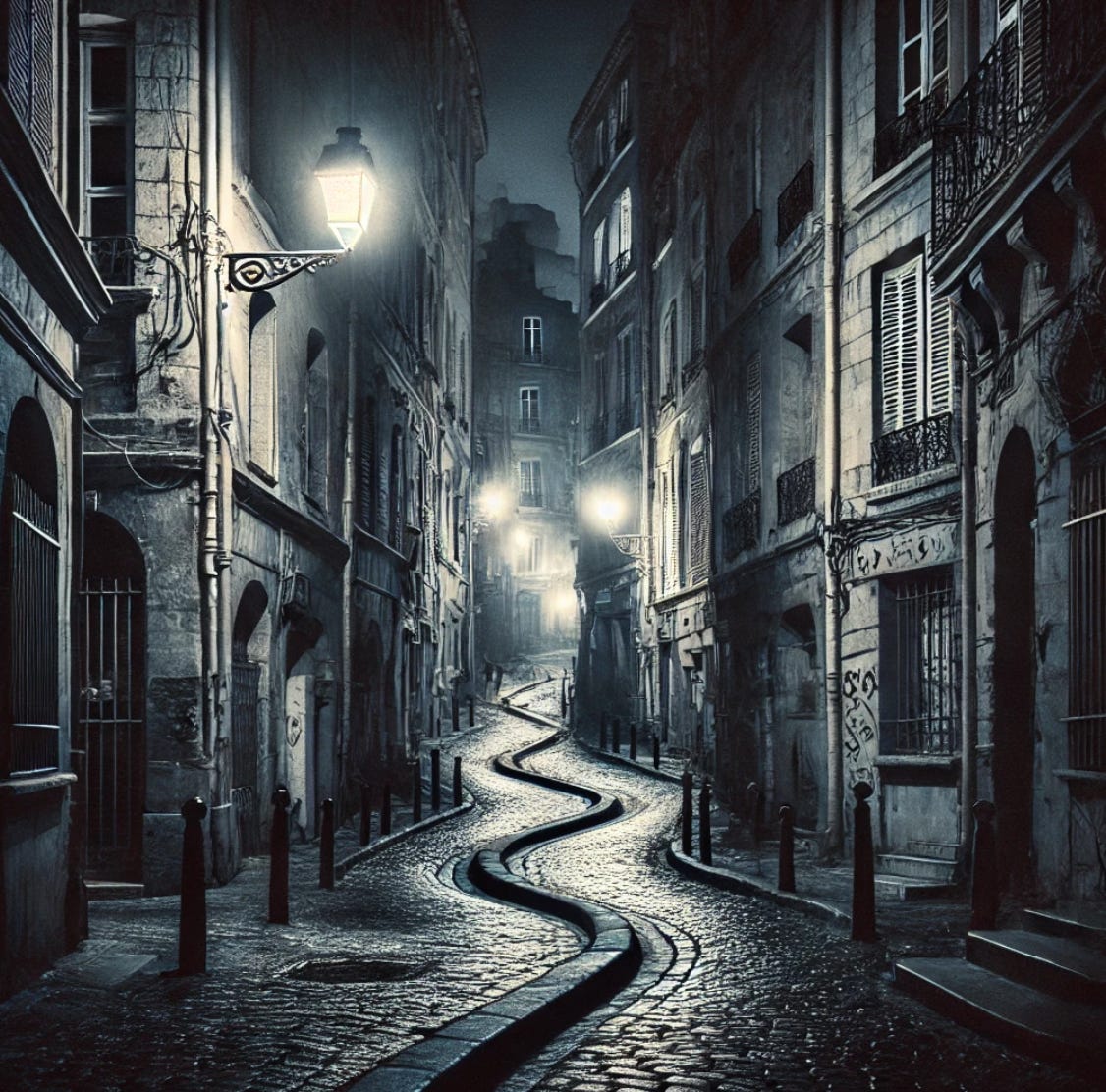
I’ll never forget arriving in Marseille around midnight, France’s second largest city. From the train station, I randomly chose a direction to find a hotel, avoiding the one across the avenue from the station thinking it would be too expensive. I walked through dark, empty streets, into what must have been residential areas with an occasional dark plaza, occasionally passing a café where men gathered around coffee cups and hookahs—no women in sight.
The streets look like a labyrinth, dark and narrow, and I was hoping for any hotel. The fear center in my brain lit up, sparking the release of cortisol, and I became hyper-aware of sound, shadow, and any movement in my periphery. I didn’t care how much it cost, I’d stay the first place I find and put it on a nearly maxed-out credit card and worry about it later.
Finally, I spotted a bright red sign: IBIS.
I dragged my suitcase up the steps and asked for a room, and was relieved they had one at a reasonable price.
Somehow, I knew I was going to experience magick in this city. I could feel it. To be frank, what brought me to Marseille in the first place was dead spirts and the possibility of death. I was going through my Looking-for-Duende stage of creative development. This was a time when I believed that sometimes, when I’m writing and time disappears, when I reach the Writer’s High, the voice of a spirit can come to me and take over the language and direction of the piece. I could channel the dead, not only those from my memories, but the sprits from where I’m writing. Some places had more duende than others, like Fresno and El Paso, the two cities I call home, where the hot air in your nostrils can burn like regret.
I visited Marseille because I thought there would be a unique energy about the city. In the 14th century the Black Death destroyed half the population, and there were brutal religious wars, cholera, and World War II, all of them wiping out masses of people. There had to be a feeling to the city, I thought, being a young writer searching for duende. I had no agenda. No itinerary. I just wanted to walk the city and search. My week there turned out to be one of the life-changing moments of my artistic and spiritual story. It was there that I learned to see the dead.
Today, if I entered Marseille for the first time after midnight, it would be a different experience, not only because I am much older now and no longer at the Duende stage of my development, but also because the experience of walking the streets hoping for a hotel to appear would not have happened in the same way. Now, all I would do is pull out my phone and check the map for directions to one, and I would probably read the Yelp reviews. I would follow a little flashing arrow on my screen, moving with me like footsteps on a Harry Potter map, and maybe I would look up at the real city only half the time, missing the mend gathered around tables drinking mint tea and coffee. I could text my loved ones and let them know I was all right. We live in a world with minimal uncertainty. There are fewer surprises in our lives, and a good percentage of them are curated by the algorithms that appear on our devices.
A good practice for writers is to break away from devices and habits. Take a walk without your phone. Go for a drive. Disconnect not just from your device but from the routines that structure your days.
For two weeks I immersed myself in Marseille, a city I knew little about except that it was the number one producer of hip-hop in France. I was a fan of Fonky Family.

And of course, I knew it was a city that had suffered great tragedies. I didn’t know anyone there. I didn’t know what to expect, and it was glorious.
One day, I hopped on a crowded bus full of locals heading to the beach—Black and brown faces like mine, laughter, a sense of community. Some kid had a boom box and was blasting 2Pac. When we arrived, everyone rushed out toward the water and ran, and I got in the spirit and ran to the water with them.
It was imperfect, unpredictable, and beautiful.