
Minnesota Is Magick
A Real Example of Nepantla Realism

So I was on my way to a small town in Minnesota, where I was interviewing for the Fiction Writer position at a rural state university. The town was so far away from a major airport that no one from the university could pick me up–it would take an entire day– so they rented me a car and I had to drive three hours into the prairie.
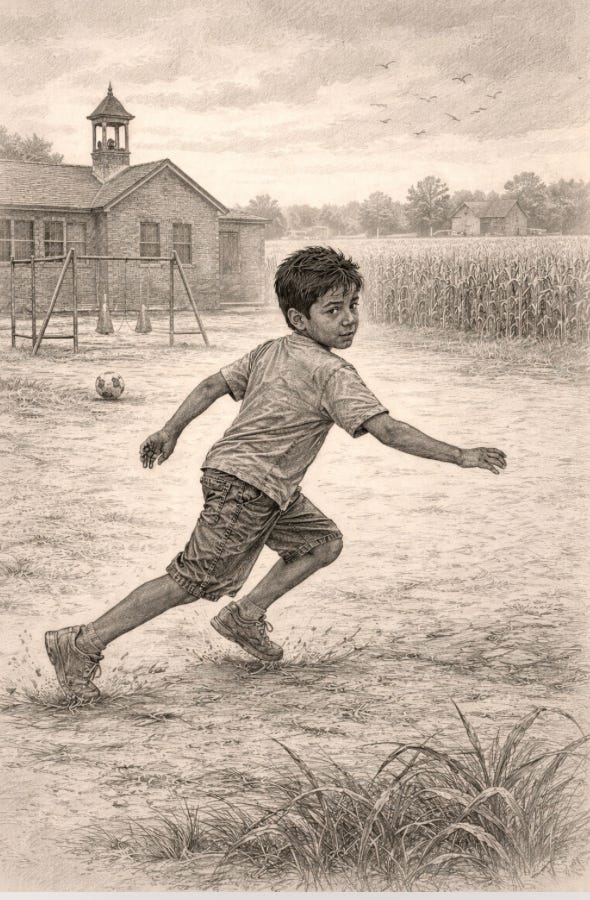
The two-lane highway cut through endless cornfields, like the setting of a Stephen King movie, and when I entered a town whose name I didn’t encode –maybe Gaylord or Gibbon– I slowed, cruising down the main street, thinking it could be a speed trap. I passed an elementary school and it must have been during recess, because kids were playing in the schoolyard. I could hear their screams ricochet in and out of the wind and shoot like sprits into the expanse of cornfields beyond the school. That’s when I saw the brown kid playing with the other kids, only one dark brown, maybe a Mexican maybe an Indian boy among all the white kids. He seemed to be playing tag or some zigzag running game with other boys. I imagined myself inside of the mind of that kid, surrounded by a blur of white faces, whose stories were so different from mine. I realized if I got the job and moved out here from California, I would stand out like that boy. He was another version of me, mi otro yo.
On my first evening in the university town, I did a reading for their creative writing community, and afterwards, they threw a party at the house of a faculty member. They called me Danielle, because they were trying to say Daniel in Spanish. Everyone was drinking and laughing and someone brought their guitar and strummed a few James Taylor tunes.
I was almost in tears, because between my reading and the party, I had time to check my email, and I got devastating news from home. I was distant and untalkative.
I struggled to keep up with conversations, which made me seem arrogant and indifferent. I knew I wasn’t going to get the job so I quit trying. I wasn’t the only one they were interviewing. I pictured another party just like this with the other candidates standing in my place. Let them have it, I thought. I’ll go back to California and repair my life.
They kept asking me questions about my writing, my opinion on writers, and one very tall white man–the spouse of a professor–asked me about being a Chicano writer: Do I consider myself one? Or am I just a writer who happens to be Chicano? I shook my head, a silent “no” and he looked confused, not sure what was happening. Oh, he said and walked away.
The chair of the department asked me to step outside for a minute. It was cold that night, the wind so strong we had to yell into it. Across the street there was a fire hydrant and attached to it, reaching into the sky was what looked like a rubber ruler. What is that I asked?
It’s so they can find the hydrant in the snow, she said.
Oh, shit! I said, wondering if I could ever live there.
Are you okay? she asked, her lips wrinkling up with cold. Are these idiots offending you with their questions?
I liked her. She was in her sixties, an open lesbian in a conservative town of 12,000 people. I tried to tell her that everything was fine, it’s just that I had heard some bad news. I wasn’t going to tell her what it was, but before I could say I’m fine, I started bawling right in front of her. It was embarrassing.
She hugged me, kept gently squeezing me. I didn’t know she would soon die of cancer, but it felt good to be held. I pulled away, wiped my tears, and said, Sorry. This is not cool. Not a great interview technique.
Oh, don’t be so macho, she said, like an aunt chastising her nephew.
I kept saying through my tears and sniffles, I’m sorry. This isn’t very professional.
Fuck professional, she said. You stay here. I’m going to tell them we have to go.
But they threw the party for me.
Writers don’t need a reason to have a party, she said.
She went in.
I could hear inside the guitar playing, and there was singing and laughing, but then it got silent and I heard whispers.
Once in my hotel room, I was restless, I couldn’t think about the next day’s agenda, when I was supposed to meet with the university president. I sat on the bed with the remote and thumbed through the channels on mute, flashing image after image–a black man playing golf, a cartoon turtle spinning in a whirlwind, a white woman dying of cancer on her hospice bed, images flashing as fast as my thumb could click.
I got up, put on my coat and went outside to smoke a cigarette. It was cold and windy, and it wasn’t even winter, it was spring. Why would I move from urban California to rural Minnesota? No way! I closed my eyes, felt the cold wind wash over my face, took in a long drag of the cigarette and blew it out slowly.
I heard the wind whistle, felt its twirl and imaged I was Tooter Turtle.
Help, Mr. Wizard!
In Hebrew the word for wind, רוח, is also the word for spirit, Ruach, as in a divine spirit, and in my imagination, the spirit of the wind was taking me away, my face awash with angels, blowing me this way and that like a wave on the sea.
Then I heard a car horn, and I was standing against the hotel wall. Across the hotel parking and some tall grass bending in the wind –and I could see the small indoor mall. That’s when I saw someone I knew.
At first, I could hardly believe it. How was it possible I knew someone in this town?
He was walking out of the mall, and I realized I was seeing myself. I saw myself walking out of the mall and get into a hunter green Toyota pickup with a camper shell I had installed for Felix. It was my truck! And me.
Fuck! I said, like I had just lost a bet.
I knew what I saw was real.
I knew I would be offered the job and that I would take it. Marshall would be my home. I knew this with such certainty that the next day when I met with the university president, I made bold salary requirements. He winced. I also told him I would also need a course release my first year and a five-thousand dollar travel budget. That’s. . . he said. . . a lot.
I’m worth it, I said.
Time-jump to six months later, and I was living on the prairie.
I have since been on countless search committees, participated in countless faculty visits, and not once have we thrown a job candidate a party. We take them out to dinner, drop them back off at the hotel, and then pick them up the next day for breakfast. We do not throw a party. These were details (Borges says every detail is an omen) I hadn’t yet processed in my mind, but I must have felt it my gut. Despite or maybe because of my behavior at the party, they would make me the offer. I was sensitive. I cried in front of the chair! That’s the kind of Latino man we want. We don’t want some macho. We want a Chicano man who can cry.
To live as a writer is to live between realities. This isn’t magical realism. This is Nepantla.