

“Human brains and computing machines will be coupled together very tightly, and the resulting partnership will think as no human brain has ever thought. . .”
J.C.R. Licklider, Man-Computer Symbiosis, 1960
When he would get home from school, Lick would throw books on the bed and go to the garage where the car was waiting for him like a lonely robot. He had found the corpse of the roadster in a field of weeds and urged his parents to let him have it. It was a machine–and he loved machines– and even though all that was left of the car was the body and some rusty metallic joints, he knew he could rebuild the engine and re-configure all the moving parts, get the pistons drumming, the carburetor pumping gas into the fuel line. He could imagine it zipping across the road like a metal demigod with purpose.
When the day came when the work was done, he closed his eyes and turned the key. It was supposed to purr. It purred. When he pressed his foot on the gas pedal, still in neutral, it was supposed to roar, and it roared. What a feeling that must have been! He must’ve thought that machine and his own spirit were connected. He wasn’t a religious boy, but his father was a Baptist minister, so maybe he imagined his soul became one with the machine. Like God with Adam, he breathed life into it.
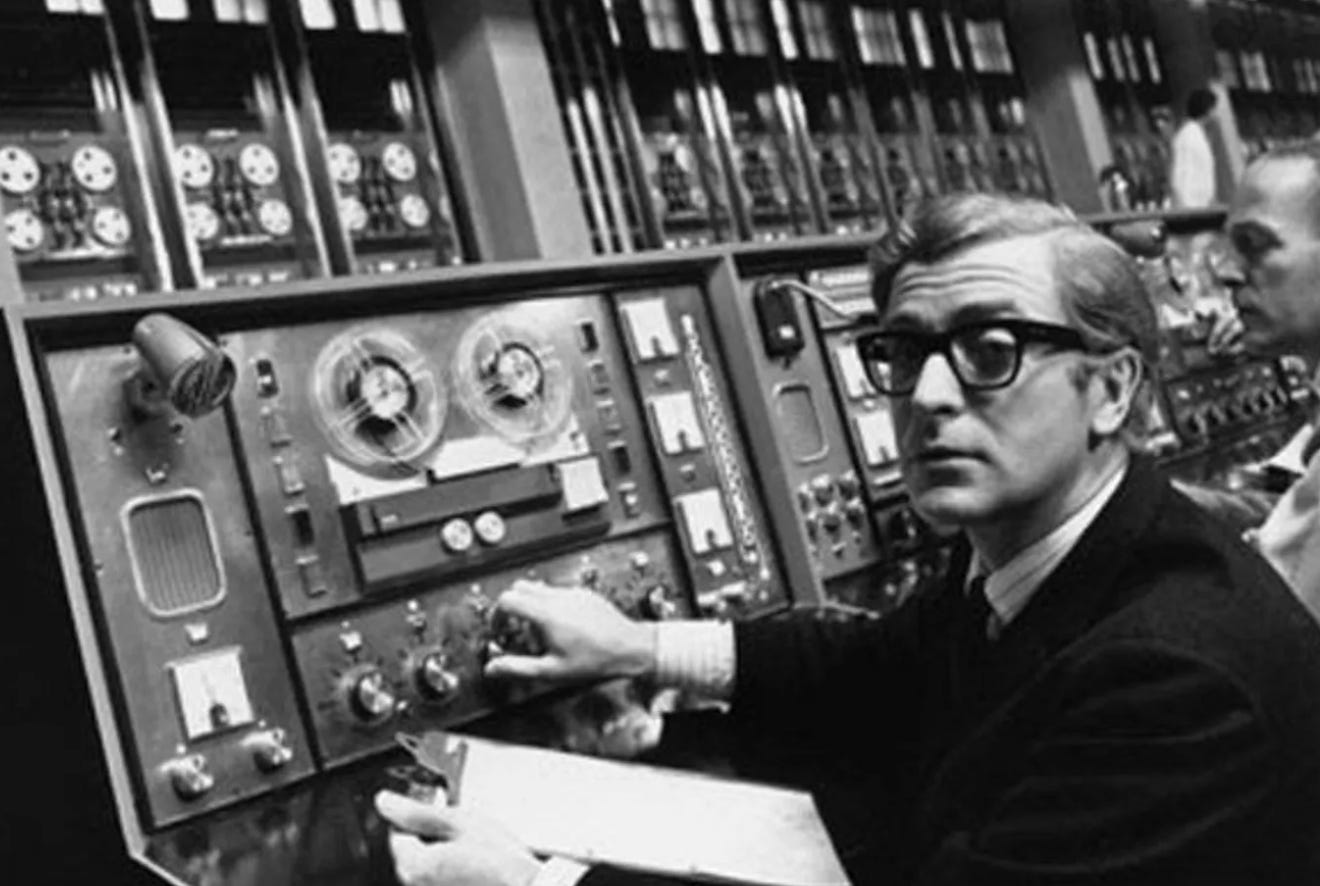
Obviously, a car isn't a computer, but tinkering with motors and clocks and any mechanical thing around the house must have led to his insight into computers and systems. Years later, in 1960, when he was a Psychologist-turned computing visionary, J.R.C. Licklider (Lick to his friends) wrote a manifesto called “The Man-Computer Symbiosis” in which he writes the above quote.
It reminds me of an image I associate with Coders by Clive Thompson, where suburban kids with Commodore 64's would write code late into the night just to see what they could get the computer to do, maybe hooking it up to a mechanical arm and watch it push a cup off the desk, howling with delight when it works.
Lick didn’t have a Commodore 64 when he was a kid—because they didn’t exist yet. His insight came twenty years before personal computers, before there were calculators, palm pilots and the devices in our hands or over our eyes that compute more information than a room full of government computers from 1960. Back then, a team of mostly women coders (yes, the first coders were women) would have to face a pile of punch cards and be very specific about what holes they punched (what chads were left hanging) before they fed the cards one by one into the machine, and even if there was one tiny wrong hole in the card, they would have to start over again. But the answers it would give could potentially save years of human cognitive energy.
How did Lick know?
He is largely credited as a creator or oracle of the Internet, believing there could be an informational system shared across computers in what later would become the cloud. Lick predicted the future, because he was moving towards it, and he knew the emerging computational ability of machines could be used not only to carry out human goals, but to enhance the parts of the brain responsible for processing and storing information. Like the hippocampus, where our memories are stored. He believed the partnership of human and machine could make all us brilliant! Aristotle famously said, to learn is to remember, and that’s the problem isn’t it? We always forget what we learn. But what if we didn’t have to? What if everything we have ever learned as humans were readily available not only for recall but for processing and decision making?
Today anybody can have advanced brains by outsourcing some of the cognitive functions that take up too much mental bandwidth.
He was right. This is obvious today. Our brains are enhanced by our devices, which is to say, we outsource some of our cognitive work to machines.
But I’m afraid Lick was a bit too optimistic in a bourgeois life that would allow him, as a kid, to convince his parents to bring a giant car into their house. He even had a private garage to work in, but not everybody has those advantages.
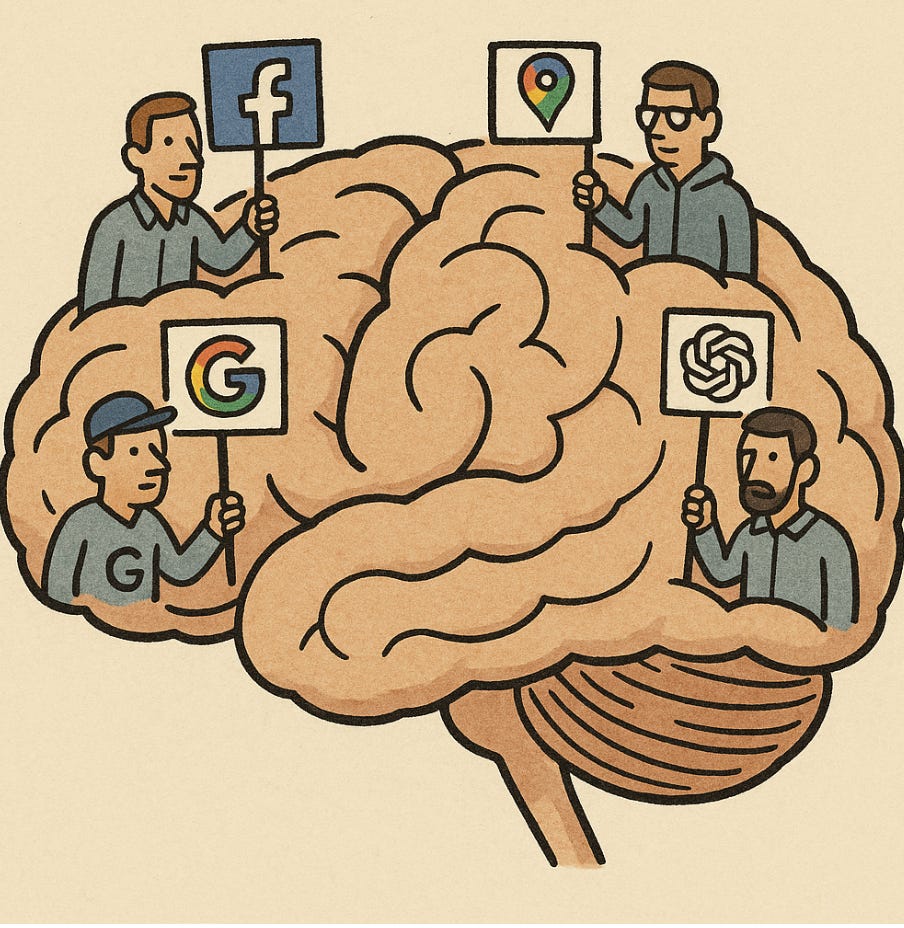
Lick was not able to imagine how the same processing ability that would allow his brain to partner with computational devices can and will enslave others. Today computational power is used to aggressively to keep people under submission. Most people are not cognitively enhanced by their devices; they are subservient to them. They are vulnerable to algorithms that are designed to access the mechanisms of their brain and cause them to continue to use those devices. They are designed to keep people engaged, to shape their behavior according to algorithms.
Even though for some people LLMs might be cognitive enhancers, they can also make us stupid by not requiring us to think. For those who have little AI literacy, devices make many people less smart, not smarter. It causes their brains to function in loops and patterns.
But he’s right for some people. AI is accelerating how some people can use the technology for cognition and can definitely be smarter.
We cannot ignore this technology and AI, but we can learn how to use it to enhance our lives, not to highjack our limbic system and do our thinking.
To return to the metaphor we began with—Lick picking a car from an empty field and towing it home to fix it up—we are not so much working on the car as allowing the car to work on us. The car is smarter than us in certain ways, and it wants to open up our brains and tinker around until it can get us to do the will of its creators.
Aristotle said to learn is to remember. But the machine remembers everything for us—and in doing so, it begins to shape what we are allowed to learn, to recall, to decide.
That’s not cognitive enhancement.
That is colonization of the human brain.
I wonder if he knew about Paul Otlet. Otlet envisioned an interconnected world of information. He was regarded as a founder of information science during the turn of the 19th century.