

I might be a little crazy, but I like to imagine that the consciousness of the poet can travel to other realms, to the astral plane or the multiverse, that we can sometimes soul travel to the various levels of heaven or down into the dark basements of our unconscious minds. The metaphor you use to describe this experience depends on how you scaffold reality, but it happens to all writers, getting lost in the imaginary world and before you know it, hours have passed and you’ve written more pages than you thought possible, and what you have written often surprises you.
Writing is Deep Work, because it requires our total absorption, and when we write fiction or poetry in this state, we are discovering realities parallel to the one in which we live. We are experiencing Flow. We are writing poetic code.
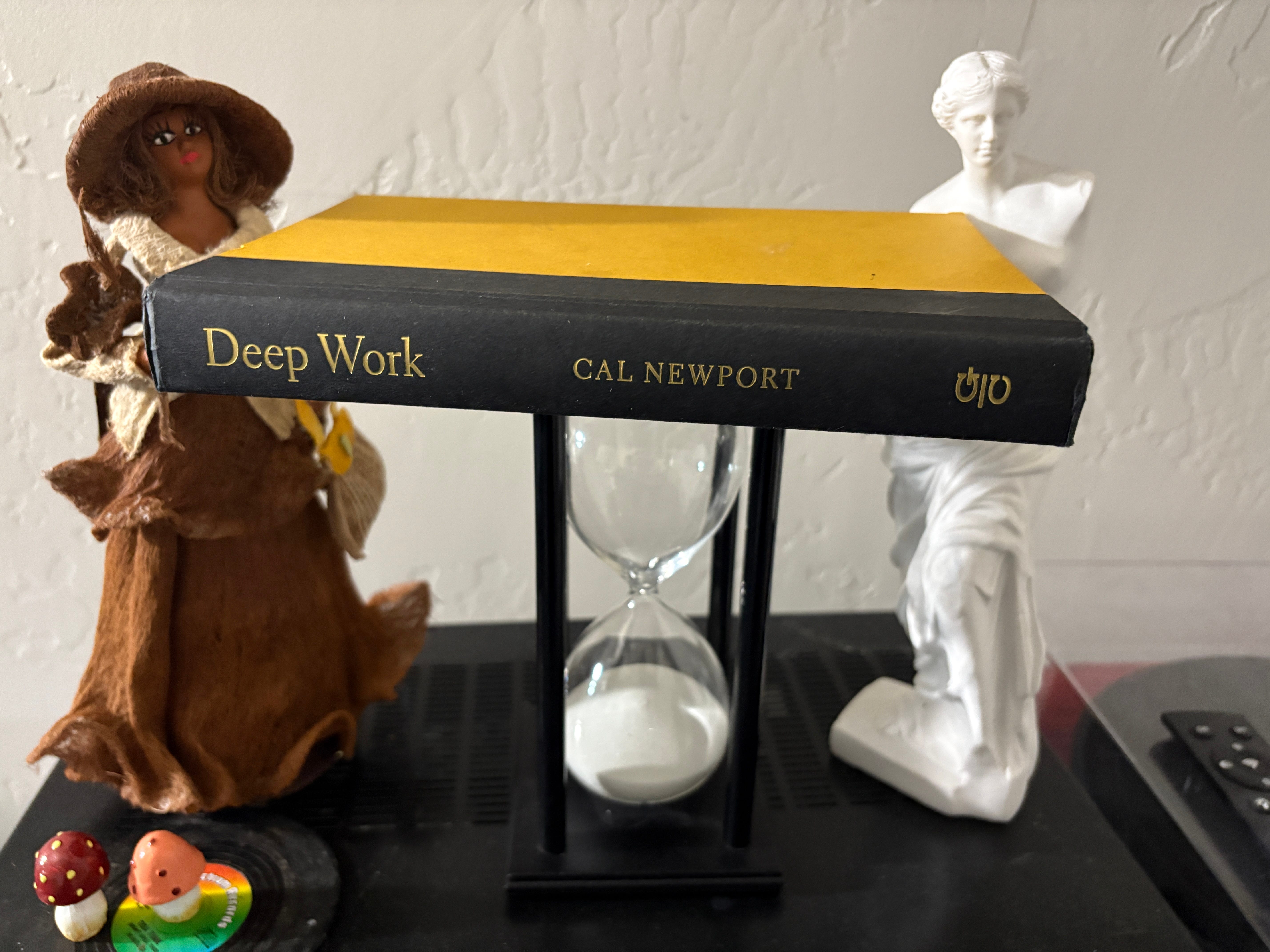
Deep Work by Cal Newport is a great book for creative writers who want to hone the ability to reach Flow and to have more consistent sessions. Newport writes mostly about coders and scientists and other so called “left-brain” thinkers, offering advice and protocols on how they can optimize their focus --hack their brains as it were -- to have consistently productive sessions of deep work, but he includes many examples of creative writers and philosophers.
Most of my life, I have been a harsh critic of myself, sometimes to the point of depression, often berating myself for not being able to write for longer sessions. Why can’t I spend an entire day just writing? Maybe I’m not a writer, I’d think, and because I have lived with what is now called ADHD, my mind flitters in between thoughts and feelings, often making it difficult to do the focused work that needs to be done.
Enter one of the most exciting ideas in Deep Work, something cognitive scientists agree upon: Most sessions of deep work or Flow last ninety minutes at most, sometimes much shorter.
If somebody tells you they write all day long, they're probably using an amplified definition of writing.
Sure, I could write all day long.
No problem.
But apart from Flow or doing those often laborious tasks of revising and editing, my Writing Day includes taking a walk, stretching my body on a yoga mat, drinking a glass of cold water as I look out the window. “Writing all day” means not checking emails or going on social media ingesting information that takes me away from the work.
It’s helpful to know that those in-between times, when we are not in the state of Flow, what we do, from sitting alone in a room and thinking to washing dishes, can be opportunities to hone our ability to maintain longer sessions in the future. Later on, I will write about the Default Mode of Consciousness and how we can direct the thoughts that come to us during mundane moments, in order to enhance our cognition and Imagination, but for now it’s important to know that a productive day does not mean eight hours of pure focus. I mean, not without pharmaceuticals.

One of the greatest take-aways from Newport’s book is the FACT that deep work, whether you’re a professor or a poet, is becoming rarer. We writers are going to be valued more and more in the age of AI and algorithms, because very few people today can do the Deep Work that we do.
Many people can’t focus long enough to even read a book, let alone write one, because they’re so distracted by emails, social media, social anxieties.
Newport writes:
“Knowledge workers (read: WRITERS) are tending towards increasingly visible busyness, because they lack a better way to demonstrate their value.”
Instead of writing, we're on social media talking about what we’re going to write. Or we're checking emails, writing and answering them as if they were urgent and important. They’re not. (Evoke Stephen Covey’s 7 Habits of Highly Effective People much?)
Sometimes we do any shallow work that will demonstrate to others (even ourselves) that twe are busy. We are doing work. The problem is that visible busyness means we're not writing!
I recommend this book for writers, who already depend upon deep work for what they care about, art, poetry, fiction, philosophy.
Writers cannot wait on the muse. When the muse is there, fantastic!
But we want to find portals into the realms of possibility, and sometimes the muse might simply be the gatekeeper that lets us in. We can rise to even higher (or lower) levels of consciousness and imagination, even if we can only linger there for short bursts of time.
Again, let me emphasize the most important concept from Newport’s Deep Work is that the ability to focus is increasingly rare, and those who are able to do it will be the leaders of the future. That includes us, fiction, writers, poets, writers across the genres.
Writers can shape the future.
Love these posts. They remind me to write and acknowledge that even I don't have all the answers. "Writers can't wait on the muse." Great concept.
Thank you for sharing these. I've read digital minimalism and I've added Deep Work to my list.