

When mystic Swedenborg was young he liked to make things with his hands. He practiced bookbinding, cabinet making, watchmaking, and he got good at all of them, could have made a decent living had he chosen any of them. He went on to create scientific instruments and maps that he put on globes and he spent hours going deeply into sacred texts where he uncovered secrets of the universe, of which he wrote thousands of pages, which remain some of the world’s most influential mystical books like Heaven and Hell, where he introduced the idea of Correspondences, which influenced and helped shape symbolic poetry. Imagine the focus necessary for each of these tasks. Even exegesis itself, to do deep readings of great passages from great books, is most productive when you reach the state of Flow, which means he was often leaving his body behind while his spirit and mind flew into ethereal spaces.
Although they are distinct states of consciousness, Flow corresponds with hypnagogia, that state of consciousness right before sleep when random images flash in your head and you know you are about to doze off. These two states of consciousness together are magical keys to the kingdom of Nepantla. Hypnagogia increases activity in the pineal gland, where melatonin is produced, that hormone that alerts you that sleep is about to come and the images flash. Flow increases the release of endocannabinoids, the “bliss molecule,” which brings on that feeling of connection and joy, basically getting you high. Endocannabinoids use the same receptors as THC, cannabis, marijuana, as in, Don’t bogart that joint, my friend!
In Flow + hypnagogia you lose sense of yourself, your identity, your body. You are so focused on your task that you forget time, you forget space, you even forget to eat. If you are driven or obsessed, like many writers, you work well into the night –even when melatonin is pulling you toward sleep. Hypnagogic images flash in your head, and the Flow of endocannabinoids delights in them, so they find they their way into the work. When I’m writing a story and I am so involved, so absorbed in that world, but I’m also experiencing involuntary images while my body is fighting sleep, the images often end up in the work. Swedenborg is famous for not only his ability to focus on new tasks, but also how he would go day sometimes without sleeping. Imagine walking the streets of London late at night without any sleep for days focused on some question about heaven. Images of angels will flash into your mind and feed your creativity.
Flow is how he began talking with angels.
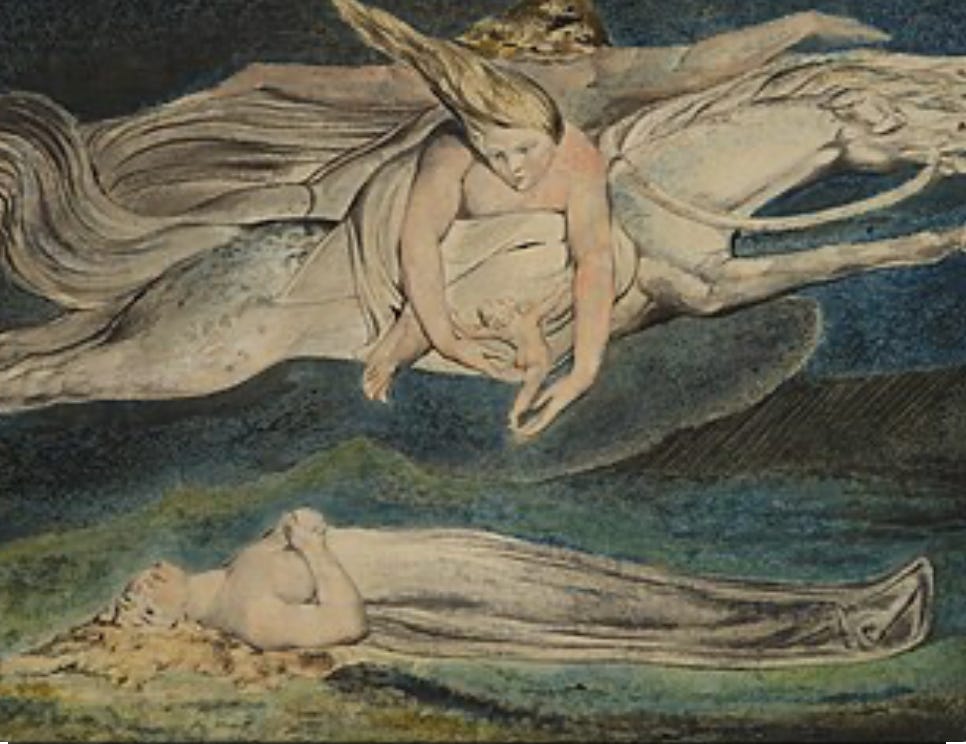
Poets talk to angels, or, to evoke poet Omar Salinas, the crazy gypsy of Fresno, they bite at our fingernails as we’re writing. To be in The Writer’s High (how we experience Flow) is to talk with angels. Time disappears, and because during Flow your prefrontal cortex is diminished, you’re not telling a story about you, you’re following something bigger, deeper, smarter than you. You can enter into a realm without time, where images and sounds swirl all around; and because there is no time, you interact with thought-beings who have arrived from different spacetimes, to the same mundus imaginalis.
You could be a poet writing, and suddenly you see a crossroad and there are Indigenous women dancing –their long dresses twirling– and they carry baskets of candy. As you are experiencing this (writing it) you may look across the road and see Lorca on the other side looking at the same image, but instead of watching Purépecha women on the Islands of Janitzo, he’s seeing gypsies on the road to Córdoba. And if you are able to linger there, you can stand next to Lorca and watch the dancing together. You can even have a conversation.
Of course, in “real” life Lorca is dead and you are not. He is the angel you talk to.
But because time doesn’t exist in that world, it’s also true that you are dead and Lorca is living, so you are his angel.